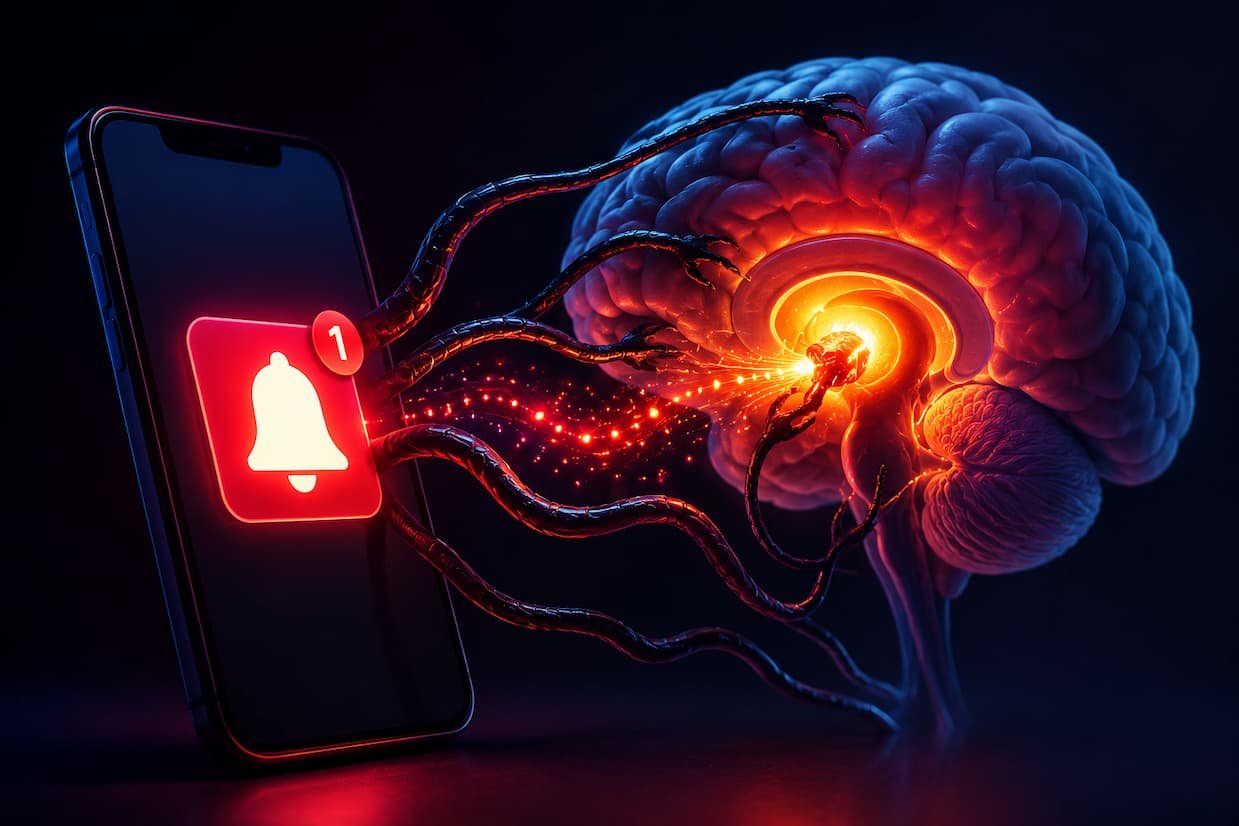
Your phone just buzzed. You don’t know what it is. You don’t know who it’s from. You don’t even know if it matters. But you already want to check it. That wanting — that itch in your fingertips, that pull in your gut — is not a sign of weakness. It is a sign that the system is working exactly as designed.
Notifications are not communication tools. They are slot machines. And your brain is the coin.
The Variable Reward Trap
Slot machines work on a principle called variable rewards. Sometimes you win. Most times you lose. But you never know which pull will pay off, so you keep pulling. The uncertainty is the drug. Not the reward itself — the anticipation of it.
Your phone operates on the exact same circuitry. Every notification is a potential reward. A like from someone you care about. A message that matters. A piece of news you actually need. But most of the time? It is a spam email, a promotional push, a random app update you did not ask for. The ratio does not matter. The possibility matters. Your brain treats every buzz as a survival cue because, for most of human history, novel information meant danger or opportunity. A rustle in the bushes could be a predator or prey. Your ancestors who ignored novel stimuli did not survive to pass on their genes.
So when your phone buzzes, your ventral tegmental area — a cluster of neurons deep in your midbrain — fires. Dopamine releases along the mesolimbic pathway to the nucleus accumbens. This is not pleasure. It is drive. It is want. It is the same neural circuit that drives hunger, thirst, and the pursuit of mates. The tech industry did not accidentally stumble into this. They hired neuroscientists to weaponize it.
The Math Is Brutal
The average person receives between 46 and 63 notifications per day. That is one every 15 to 20 minutes during waking hours. Each one triggers an orienting response — an automatic, involuntary shift of attention. Even if you do not check the phone, your brain has already allocated resources to process the alert. Over a year, that is roughly 17,000 attention fractures. No wonder focus feels impossible.
What the Research Actually Says About Turning Them Off
Here is where the story gets interesting. The research on disabling notifications is not the clean victory lap you might expect.
A 2017 field experiment by Pielot and Rello had 30 volunteers disable notifications for 24 hours. The results were mixed. People felt less distracted and more productive. They found it easier to concentrate on desktop work. But they also felt less connected to their social groups. Some friends got annoyed. Participants reported anxiety about missing important information — a delivery driver, an urgent message, a family emergency. That anxiety did not translate into higher stress overall, but it was real. Two years later, more than half of the participants had made permanent changes to their notification settings — mostly turning off social media alerts while keeping SMS.
A larger 2024 randomized controlled trial with 205 participants took a different approach. They disabled notifications for a full week and tracked both subjective experiences and objective phone behavior. The result? Screen time did not drop. Checking frequency did not drop. People still picked up their phones just as often. What did change was their perception of their own behavior. Without notifications, checking felt more intentional. Less habitual. The phone became a tool they used rather than a slot machine that used them.
But there was a catch. Disabling notifications increased fear of missing out — both the fear of missing specific notifications and the fear of missing online content generally. This “notification-FoMO” and “content-FoMO” spiked early in the week and then gradually declined. The researchers suggested longer interventions might be needed for the drawbacks to fully fade.
The Productivity Paradox
A 2023 field experiment with 247 working participants found that disabling notifications improved performance and reduced strain — but only for certain people. Those with low to medium fear of missing out benefited the most. Those with high FoMO actually saw smaller productivity gains, possibly because the anxiety of not knowing what they were missing created cognitive load that offset the benefit of fewer interruptions. The takeaway: turning off notifications works, but the transition period matters. Your brain needs time to recalibrate.
The Workplace Numbers Are Worse Than You Think
In 2024, Unily surveyed 500 UK employees about digital noise. The results were staggering:
- 77% found workplace notifications distracting
- 31% were interrupted every 15 minutes
- 59% said digital tools contributed to their stress
- 45% said the notifications they received were irrelevant to their jobs
That is 160 distractions per week for the average worker. At 23 minutes to refocus after each interruption — the widely cited figure from UC Irvine research — that is over 60 hours of lost cognitive capacity per week. Obviously, not every distraction costs a full 23 minutes. Some are brief. But even at a fraction of that cost, the cumulative damage to deep work is catastrophic.
Managers were hit even harder. 59% of managers reported a distraction every 30 minutes or less, compared to 48% of all employees. The people who most need uninterrupted thinking time are the ones getting it least.
The Tragedy of the Commons
Pielot and Rello described the notification economy as a “tragedy of the commons.” Every app, every platform, every service is competing for the same finite resource: your attention. Individually, each notification seems reasonable. Collectively, they create a cacophony that fragments cognition, elevates stress, and degrades the quality of everything you do. No single app is the villain. The system is the villain. And the only way to win is to opt out of the system.
How to Actually Do This Without Destroying Your Social Life
Turning off every notification is not practical for most people. You have a job. You have family. You have obligations that require timely responses. The goal is not digital asceticism. The goal is intentional curation.
Start here:
- Kill the noise first. Social media notifications are the lowest-hanging fruit. Nothing on Instagram, TikTok, Twitter, or Facebook requires your immediate attention. Turn them all off. Every single one. If something truly matters, someone will text you.
- Batch your email. Check email at scheduled intervals — morning, midday, late afternoon. Disable push notifications for your inbox. The world will not end if someone waits two hours for a reply. In fact, a University of British Columbia study found that people who checked email only three times a day reported significantly lower stress and better focus.
- Keep SMS and calls. These are the channels people use for actual urgency. A text from your partner. A call from your child’s school. These stay on. Everything else gets demoted.
- Use Do Not Disturb with exceptions. iOS and Android both allow you to whitelist specific contacts during DND hours. Set this up. Your boss can reach you during work hours. Your mother can reach you always. The rest can wait.
- Accept the withdrawal. The first 48 to 72 hours without constant pings will feel wrong. Your hand will reach for your phone reflexively. You will wonder what you are missing. This is not a sign that you need the notifications back. It is a sign that the addiction was real. The discomfort passes. Usually by day four or five, the phantom buzzing stops and your attention span starts to recover.
The Deeper Problem
Notifications are a symptom. The disease is a culture that equates availability with virtue. We have built an economy where responsiveness is a proxy for commitment, where “seen at 2:47 PM” is a social contract, where not replying within an hour is interpreted as disrespect.
This is unsustainable. And it is not your fault that you feel overwhelmed. The system is designed to overwhelm you. Every app wants your attention. Every platform wants your engagement. Every notification is a tiny tax on your cognitive resources, and the bill comes due in the form of exhaustion, anxiety, and the nagging sense that you are never quite caught up.
The research is clear: reducing notifications improves focus, reduces stress, and restores a sense of control. The effect is not always immediate — there is a transition cost, especially for people high in fear of missing out. But the long-term payoff is real and measurable.
Conclusion
Your dopamine system is not broken. It is being exploited. The notification architecture of modern smartphones is not a communication feature. It is a persuasion architecture built on the same psychological principles as gambling machines — variable rewards, intermittent reinforcement, and the deliberate cultivation of uncertainty.
You cannot out-willpower a system designed by neuroscientists to capture your attention. Willpower is a limited resource, and the apps have an unlimited budget. The only sustainable solution is structural: turn off the inputs, batch your communication, and reclaim your attention as a protected resource rather than a public commons.
The buzz in your pocket is not a friend. It is a business model. Treat it accordingly.
Related Articles
- How Your Phone Trains Your Brain to Crave Distraction
- What Happens to Your Attention Span With Constant Notifications
- Task Switching Costs You 23 Minutes of Focus Every Time
- Why Deep Work Requires Embracing Boredom
- The Afternoon Slump Is Biology, Not Laziness
- Power Naps: Finding the 20-Minute Sweet Spot
Sources and References
- PMC/NIH. “Effects of task interruptions caused by notifications on performance and strain.” Journal of Computer-Mediated Communication, 2023. https://pmc.ncbi.nlm.nih.gov/articles/PMC10244611/
- Dekker, C.A., et al. “Beyond the Buzz: Investigating the Effects of a Notification-Disabling Intervention on Smartphone Behavior and Digital Well-Being.” Media Psychology, 2024. https://refubium.fu-berlin.de/bitstream/handle/fub188/43549/Beyond%20the%20Buzz…
- Health Revolution. “Maximizing Productivity: The Power of Managing Notifications Effectively.” https://www.health-revolution.org/blog/maximizing-productivity-the-power-of-managing-notifications-effectively
- Business Insider. “STUDY: Switching off phone notifications made people feel more productive.” September 2017. https://www.businessinsider.com/study-switching-off-phone-notifications-more-productive-2017-9
- ACM Digital Library. “Perceived versus Received: A Complex Nature of Notifications.” Proceedings of the 36th Annual Conference of the European Association of Cognitive Ergonomics, 2025. https://dl.acm.org/doi/10.1145/3746175.3746200
About this article: This piece was written to expose the psychological machinery behind smartphone notifications and give readers a practical, evidence-based path toward reclaiming their attention. The research cited spans controlled trials, field experiments, and workplace surveys from 2017 to 2025. No affiliate links. No product pitches. Just science and strategy.

Aisha Patel is the main writer and editor at GameVolts, a site she built to make neuroscience and health research useful for everyday people. She covers sleep, digital wellness, beginner fitness, skin science, and productivity — always digging into the original studies rather than recycling headlines. Aisha started GameVolts because she kept finding wellness advice that contradicted itself and rarely linked to actual evidence. Her rule is simple: if she cannot explain the mechanism behind a claim, she does not publish it.