
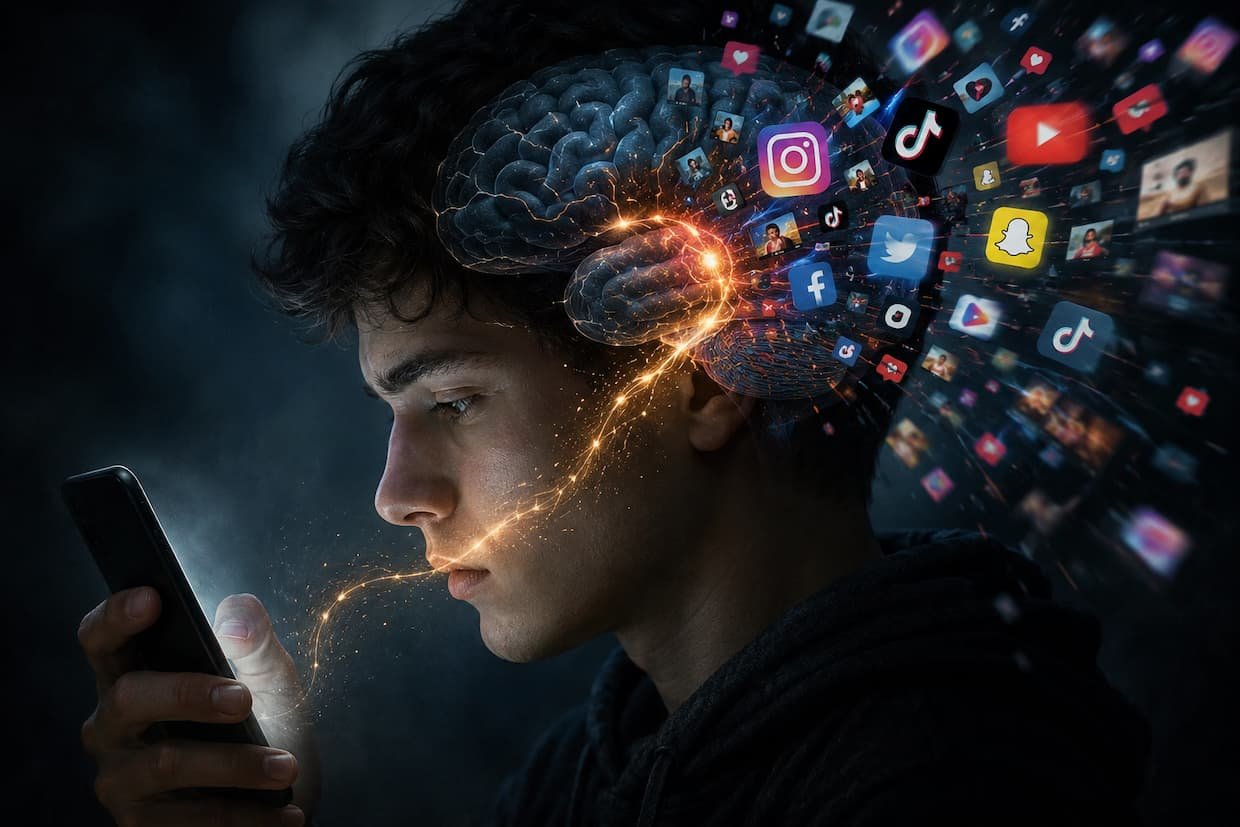
Three years ago, I deleted every social media app from my phone on a Tuesday afternoon. By Thursday evening, I had picked up my phone 47 times just to stare at the blank home screen. Not because I missed the apps. Because my brain had learned to expect a reward that was no longer there.
That is the quiet power of the modern smartphone. It does not merely distract you. It restructures the very architecture of your attention, teaching your nervous system that boredom is an emergency and that the next dopamine hit is always one swipe away.
What Dopamine Actually Does
Most people have heard dopamine described as the “pleasure chemical.” That description is wrong, and the misunderstanding matters. Dopamine is not about pleasure. It is about anticipation.
Neuroscientist Kent Berridge at the University of Michigan spent decades proving this distinction. His research showed that dopamine surges do not happen when you experience something rewarding. They happen in anticipation of the reward. The spike comes before the payoff, not during it. Think about the last time you ordered food through an app. The scrolling, the photos, the decision-making felt electric. The actual food, when it arrived, was probably just fine. That gap between anticipation and satisfaction is the dopamine system working exactly as designed.
Your brain’s dopamine circuitry runs along a pathway called the mesolimbic system, connecting the ventral tegmental area deep in your brainstem to the nucleus accumbens in the ventral striatum. When those neurons fire and flood the nucleus accumbens with dopamine, you do not feel pleasure. You feel wanting. You feel the pull. The itch. The sense that something good is about to happen and you need to find it.
What I Learned the Hard Way
I used to think turning off notifications would solve the problem. It did not. The craving was not triggered by the buzz. It was triggered by the memory of the buzz. My brain had internalized the pattern so completely that the absence of the stimulus became its own stimulus. The only thing that worked was physical distance. Phone in another room. Out of sight, and more importantly, out of reach.
How Your Phone Hijacks the Dopamine Loop
Social media platforms have built the most efficient dopamine trigger in human history. Here is how the loop works, step by step:
| Stage | What Happens | What Your Brain Feels |
|---|---|---|
| Trigger | Phone buzzes, or you feel bored, or you see the app icon | A subtle restlessness, a sense that something is waiting |
| Anticipation | VTA neurons fire, dopamine floods the nucleus accumbens | The pull. The itch. The need to check. |
| Variable Reward | You open the app. Maybe a notification. Maybe nothing. The uncertainty is the engine. | Heightened alertness. The slot machine effect. |
| Completion | You get a small hit, or you do not. Either way, the loop resets. | Brief satisfaction, then the craving for the next cycle begins. |
This is not an accident. It is behavioral engineering at scale. The platforms are not chasing bad taste. They are chasing your downregulated receptors. Their behavioral scientists run real-time optimization on what keeps your dopamine system responding at a level that keeps you on the platform. They are not guessing. They are measuring your response and adjusting the stimulus in real time.
The Brain Changes Are Real
A 2025 neuroimaging meta-analysis confirmed what researchers had suspected for years: the nucleus accumbens and the anterior cingulate cortex, the two regions most central to dopamine-driven reward and craving, activate in smartphone addicts and substance addicts in nearly identical patterns during cue exposure. Same circuits. Same mechanism. The researchers were not making an analogy. They were describing the same neurological event in two different populations.
But the changes go deeper than reward circuitry. The prefrontal cortex, the seat of executive function, sustained attention, and inhibitory control, is being systematically degraded. A 2017 EEG study found that heavy smartphone users show measurably reduced right prefrontal cortex excitability compared to controls. Not subjective reports of feeling distracted. Objective electrophysiological evidence of reduced cortical activation in the region responsible for attention and self-control.
A 2023 fMRI study went further. Researchers found aberrant function in the frontoparietal network, which coordinates executive attention and cognitive control, in excessive smartphone users across every cognitive task they tested. Not tasks involving phones. Every task. The impairment does not turn off when you put the phone down. It is a persistent feature of the system.
The Prediction Error Trap
Your brain is a prediction machine. It constantly guesses what will happen next and updates those guesses based on outcomes. When a prediction is wrong, a “prediction error” signal fires, and that signal is deeply tied to dopamine release. Social media is built on prediction errors. You never know what the next post will be. Your brain is constantly surprised, constantly updating, constantly releasing dopamine. The unpredictability is not a bug. It is the entire business model.
Why Your Brain Starts to Need the Distraction
Here is the part that feels almost unfair. Your brain does not stay calibrated to the same level of dopamine signaling indefinitely. It adjusts. It downregulates the receptors that receive the signal, reducing sensitivity so that the same input produces less response over time. This is called receptor downregulation, and it is the identical process that occurs with cocaine, alcohol, and opioids. The mechanism is the same. The dose escalates because it has to.
The dose that produced satisfaction last month does not produce it this month. This is why the content gets shorter, louder, more extreme. The tenth scroll feels less satisfying than the first because the dopamine already fired when you picked up the phone. The reward itself produces less and less dopamine response because the prediction has already done the work.
A 2024 study examined what researchers call “desire thinking” in smartphone users: the mental rehearsal of using the device. Not seeing the phone. Not receiving a notification. Just thinking about what might be there. What they found was that the rehearsal does not just reflect craving. It amplifies it. Running the simulation of what might be on the phone, who might have responded, what might have appeared in the feed, produces a stronger craving than was present before the rehearsal started.
This is why removing the phone from the room is not always sufficient. The trigger is not just the physical device. It is the cognitive habit of mental rehearsal that the device has trained into the nervous system over years of use. The simulation runs automatically, and each time it runs, it makes stopping harder.
The Cognitive Cost of Mere Presence
One of the most unsettling findings in this field comes from a study that did not even ask participants to use their phones. Researchers simply had people complete cognitive tasks while their phones were in different locations: on the desk, in a pocket or bag, or in another room entirely.
The results were striking. Participants whose phones were on the desk performed significantly worse on tasks requiring working memory and sustained attention than those whose phones were in another room. Even when the phones were powered off. Even when participants reported they were not thinking about their phones. The mere presence of the device reduced available cognitive capacity. Your brain devotes resources to monitoring the phone even when you are not consciously aware of doing so.
Can the Brain Recover?
The research is cautiously optimistic. A German study had 25 young adults reduce their phone use for just 72 hours, only allowing essential calls and work-related tasks. Before and after, participants underwent MRI scans while being shown images of smartphones alongside neutral images like flowers and boats.
The results showed noticeable changes in the brain areas linked to reward processing and cravings. Without their phones, participants’ brains became less reactive to smartphone-related triggers. Just three days of reduced phone use was enough to start reversing the effect. The brain areas that had been running in overdrive began to quiet.
A 40-day study of smartphone detox found progressive normalization of autonomic nervous system function. Heart rate variability, a reliable proxy for stress system regulation, improved over the course of the restriction period. The nervous system was coming out of a chronic low-grade activation state it had been maintaining in response to constant notification exposure.
What Actually Works
Exercise accelerates recovery through three specific mechanisms. First, it normalizes the HPA axis, which chronic smartphone use keeps elevated through constant low-grade threat activation. Second, it restores brain-derived neurotrophic factor (BDNF), which supports prefrontal cortex structure and neuroplasticity. Third, exercise produces a dopamine response through a different pathway than smartphone use, and that response is accompanied by receptor upregulation rather than downregulation. At the neurochemical level, it is the direct reversal of the process that drove the addiction. A single aerobic session has been shown to normalize brain electrical patterns in smartphone-addicted adolescents.
Breaking the Loop
Telling someone to “just stop” is not useful advice. Stopping requires sustained inhibitory control. Inhibitory control is a prefrontal function. The prefrontal function has been degraded by the pattern of use you are trying to stop. You are being asked to use the compromised system to fix itself. That does not work, and failing at it is not a character flaw.
What does work is structural intervention. Grayscale reduces the visual reward cue that initiates mental rehearsal. Notifications off eliminates the unpredictable trigger. Physical movement during high-craving windows gives the rehearsal circuit something else to do. These are not suggestions for managing screen time. They are targeted disruptions of a specific neurological feedback loop.
The 72-hour window is not the finish line. It is the opening. The plasticity that allowed the addiction to form is the same plasticity that allows recovery. Your brain built this pattern incrementally, in response to a stimulus that was engineered to exploit its natural reward architecture. It can build a different pattern, given different conditions.
Related Articles
- Task Switching Costs You 23 Minutes of Focus Every Time
- Why Deep Work Requires Embracing Boredom
- What Happens to Your Attention Span With Constant Notifications
- Notifications Hijack Your Dopamine. Turn Them Off.
- Your Brain Needs Boredom to Unlock Creative Thinking
Sources and References
- PMC: “Unveiling the grip of mobile phone addiction: an in-depth review” (2024) — Neurobiological mechanisms of MPA including dopamine system and reward circuitry.
- Frontiers in Psychiatry: “Smartphone dependence and its influence on physical and mental health” (2025) — Addiction to dopamine signaling and reward circuit activation.
- Journal of the Association for Consumer Research: “Brain Drain: The Mere Presence of One’s Own Smartphone Reduces Available Cognitive Capacity” (2017) — Cognitive capacity reduction from phone proximity.
- Neuroscience & Biobehavioral Reviews: “Effects of internet and smartphone addiction on cognitive control in adolescents and young adults: A systematic review of fMRI studies” (2025) — Executive function and reward system impairments.
- PMC: “Smartphones and Cognition: A Review of Research Exploring the Links between Mobile Technology Habits and Cognitive Functioning” (2016) — Delay of gratification and reward processing changes.
About this article: This article was written to help readers understand the neurological mechanisms behind smartphone distraction, not to shame anyone for their habits. The brain changes described here are reversible, and small structural changes to your environment can produce meaningful shifts in behavior. If you found this helpful, consider sharing it with someone who might need to hear it.

Aisha Patel is the main writer and editor at GameVolts, a site she built to make neuroscience and health research useful for everyday people. She covers sleep, digital wellness, beginner fitness, skin science, and productivity — always digging into the original studies rather than recycling headlines. Aisha started GameVolts because she kept finding wellness advice that contradicted itself and rarely linked to actual evidence. Her rule is simple: if she cannot explain the mechanism behind a claim, she does not publish it.