
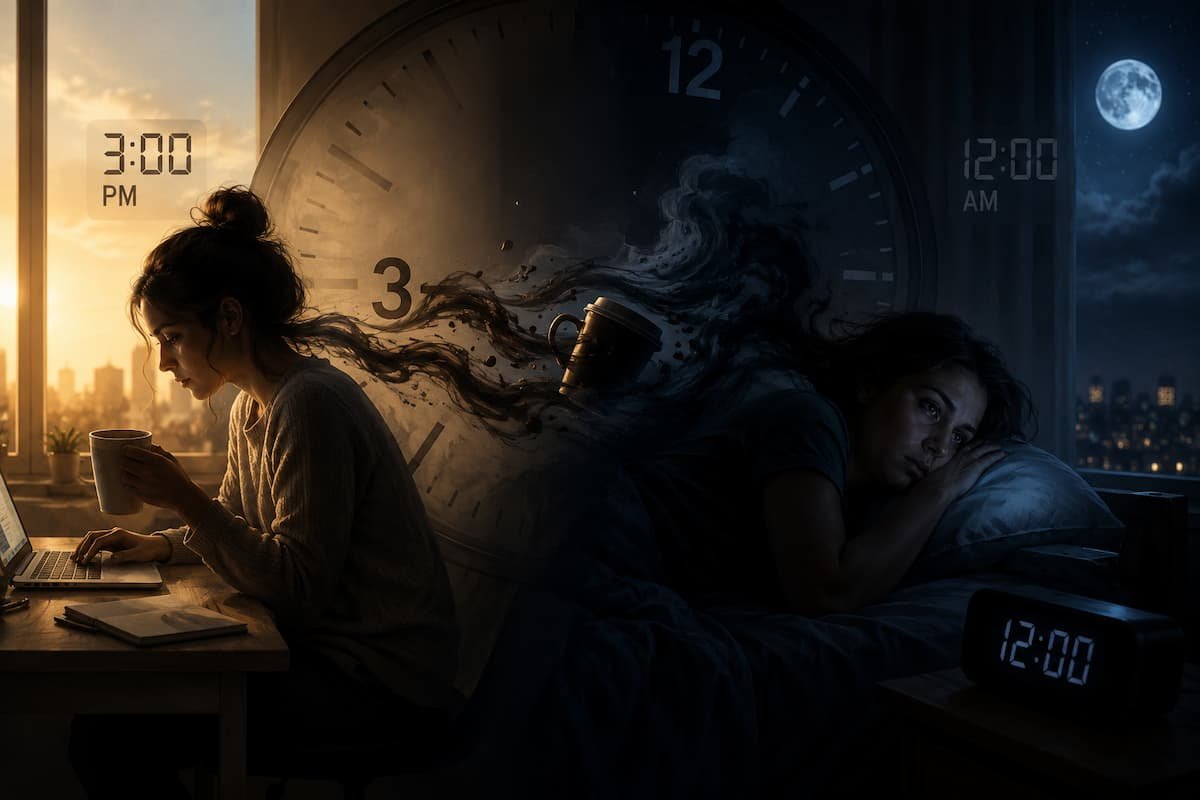
Most people think caffeine works like a light switch. Flip it on, feel alert. Flip it off and feel tired. The reality is far messier. Caffeine is more like a guest who shows up to your party, drinks all your best wine, rearranges your furniture, and then refuses to leave for hours after everyone else has gone home. By the time you realize they’ve overstayed their welcome, the damage to your sleep architecture is already done.
The Half-Life Lie We Tell Ourselves
Let’s start with the number that gets thrown around most: caffeine has a half-life of roughly 4 to 6 hours. Sounds manageable, right? If you drink 200 mg at 3 PM, by 7 PM you’ve got about 100 mg left. By 11 PM, maybe 50 mg. By midnight, perhaps 25 mg. What’s 25 mg going to do?
Here’s the problem: half-life is an average, and averages lie to individuals. Your actual half-life could be as short as 2 hours or as long as 12 hours, depending on a laundry list of biological variables. A 2023 systematic review and meta-analysis published in Sleep Medicine Reviews found that to avoid reductions in total sleep time, a standard cup of coffee (107 mg per 250 mL) should be consumed at least 8.8 hours before bedtime. For a pre-workout supplement (217.5 mg), that window stretches to 13.2 hours. That means your 3 PM espresso could still be actively sabotaging your sleep at 11 PM — and beyond.
But here’s where it gets really interesting: you might still fall asleep just fine. The meta-analysis showed that caffeine doesn’t always make it harder to fall asleep. Instead, it attacks the quality of your sleep once you’re there. It reduces slow-wave sleep — the deep, restorative phase where your brain clears metabolic waste, consolidates memories, and repairs itself. EEG studies have shown that caffeine can reduce delta wave activity (the brain waves of deep sleep) by 20% to 30% even when consumed 6 hours before bedtime. You sleep through the night, but you wake up feeling like you didn’t.
Why Your Liver Holds the Key
The reason caffeine lingers so differently in different people comes down to one enzyme in your liver: CYP1A2. This cytochrome P450 enzyme handles over 90% of caffeine metabolism, breaking it down through a process called demethylation into three main metabolites: paraxanthine (about 84%), theobromine (about 10-12%), and theophylline (about 4%).
Here’s the kicker: paraxanthine, caffeine’s primary metabolite, is just as potent as caffeine itself at blocking adenosine receptors. So even as your liver “processes” the caffeine, it’s creating a metabolite that keeps the sleep-disrupting party going. You’re not just dealing with leftover caffeine — you’re dealing with leftover caffeine and its equally disruptive offspring.
The CYP1A2 enzyme shows enormous variability between individuals — up to 15-fold differences in activity. This isn’t random. It’s written in your DNA. The CYP1A2 gene on chromosome 15q24.1 has several well-studied polymorphisms that determine whether you’re a “fast metabolizer” or a “slow metabolizer.”
| Genotype | Metabolizer Type | Approx. Population | What It Means for Your Sleep |
|---|---|---|---|
| rs762551 AA | Slow Metabolizer | ~46% | Caffeine lingers 2-3x longer; 3 PM coffee can still disrupt sleep at midnight |
| rs762551 AC or CC | Fast Metabolizer | ~54% | Caffeine clears faster; afternoon coffee may not haunt you as severely |
| CYP1A2*1C or *1K | Very Slow | Variable | Extremely prolonged half-life; even morning coffee can affect nighttime sleep |
| CYP1A2*1F (smokers) | Hyper-Inducible | Smokers | Smoking induces CYP1A2, speeding metabolism but creating dependency cycles |
If you’re a slow metabolizer — and nearly half the population is — that 3 PM coffee isn’t just “mostly gone” by midnight. A significant portion of it, and its active metabolites, are still circulating in your bloodstream, still blocking adenosine receptors, still preventing your brain from entering the deep restorative sleep it needs.
The Adenosine Receptor Blockade Nobody Talks About
To understand why caffeine haunts your sleep, you need to understand adenosine. Adenosine is a neurotransmitter that builds up in your brain throughout the day. The more you use your brain, the more adenosine accumulates. It binds to adenosine receptors (primarily A1 and A2A types), which slows neural activity and makes you feel sleepy. It’s your brain’s natural “time to rest” signal.
Caffeine is structurally similar enough to adenosine that it can slip into those same receptors and block them—but it doesn’t activate them. It just sits there, as a broken key stuck in a lock, preventing adenosine from doing its job. Your brain keeps producing adenosine (it has no off switch for that), but the receptors are occupied. The sleep pressure keeps building behind a dam that caffeine has constructed.
When caffeine finally clears enough receptors for adenosine to start binding again, the floodgates open. But here’s the cruel twist: chronic caffeine use causes your brain to upregulate adenosine receptors. It literally grows more locks because so many of them are being blocked. When you stop consuming caffeine — say, at bedtime — you now have more receptors than before, and adenosine rushes to bind all of them. This creates a paradox where you can feel both wired (from lingering caffeine) and exhausted (from surging adenosine) at the same time.
What the Research Actually Shows
Let’s look at the hard numbers. The 2023 meta-analysis by Gardiner et al. synthesized data from 24 controlled studies and found consistent, dose-dependent effects of caffeine on sleep architecture:
- Total sleep time: Reduced by 45 minutes on average
- Sleep efficiency: Decreased by 7%
- Sleep onset latency: Increased by 9 minutes
- Wake after sleep onset: Increased by 12 minutes
- Light sleep (N1): Increased by 6.1 minutes and 1.7% proportionally
- Deep sleep (N3/N4): Decreased by 11.4 minutes and 1.4% proportionally
These numbers might seem small, but deep sleep is precious. You only get about 90 to 120 minutes of it per night under ideal conditions. Losing 11 minutes of deep sleep is like losing 10% of your brain’s nightly maintenance window. Over weeks and months, this compounds into chronic sleep debt that caffeine can’t fix — no matter how much more you drink.
Perhaps most disturbingly, EEG research has demonstrated that participants often report similar subjective sleep quality whether they consumed caffeine or not. They think they slept fine. But the objective polysomnography data tells a different story: their delta wave power is significantly reduced, their sleep architecture is fragmented, and their brain isn’t getting the restorative deep sleep it needs. You’re being gaslit by your own perception.
The Withdrawal Trap
Here’s another layer of cruelty: if you’ve been drinking caffeine daily, your brain has adapted. Chronic caffeine intake upregulates adenosine receptors and alters dopamine signaling in your prefrontal cortex. When you try to cut back — perhaps because you realize your 3 PM habit is ruining your sleep — you enter caffeine withdrawal.
According to the DSM-5 and clinical literature, caffeine withdrawal symptoms typically onset within 12 to 24 hours after your last dose, peak between 20 and 51 hours, and can persist for 2 to 9 days. The hallmark symptom is headache (affecting up to 50% of people), caused by the rebound dilation of cerebral blood vessels that caffeine normally constricts. But fatigue, irritability, depressed mood, difficulty concentrating, and flu-like symptoms are also common.
Many people experiencing withdrawal symptoms — especially the crushing fatigue and headache — reach for more caffeine to feel better. This perpetuates the cycle: caffeine disrupts sleep, poor sleep makes you tired, tiredness makes you reach for caffeine, caffeine disrupts sleep again. It’s a hamster wheel, and the only way off is a deliberate, gradual taper.
What You Can Actually Do About It
Let’s be realistic. Telling people to “just stop drinking coffee” is about as useful as telling someone with insomnia to “just relax.” Caffeine is embedded in modern work culture, social rituals, and personal identity. But understanding the science gives you leverage to make smarter choices.
Know your cutoff time. The research is detailed: for standard coffee, aim for at least 8.8 hours before bedtime. For stronger doses (pre-workout, energy drinks), extend that to 13+ hours. If you go to bed at 11 PM, that means no caffeine after 2 PM for coffee, and no caffeine after 10 AM for high-dose supplements.
Consider your genetics. If you’re a slow metabolizer, your margin for error is much thinner. You might need to cut off caffeine by 10 AM or even switch to morning-only consumption. Genetic testing for CYP1A2 variants (rs762551) is increasingly available and can provide personalized guidance.
Track your sleep objectively. Don’t trust your subjective feeling of “I slept fine.” Use a sleep tracker, smartwatch, or even a simple sleep diary to monitor sleep onset time, wake episodes, and morning grogginess. If you notice patterns correlating with afternoon caffeine, you have your answer.
Taper, don’t quit cold turkey. If you decide to reduce caffeine, decrease by 25% to 50% every few days. This minimizes withdrawal symptoms and makes the transition sustainable. Replace the ritual with herbal tea, decaf coffee, or simply water — the habit of the warm cup in your hand is often as comforting as the caffeine itself.
Watch hidden sources. Caffeine hides in chocolate, certain medications, pre-workout supplements, and even some “decaf” coffees (which can contain 2 to 15 mg per cup). If you’re sensitive, these trace amounts add up.
The Bottom Line
Caffeine at 3 PM haunts you at midnight, not because you’re weak-willed or “sensitive,” but because a molecule with a 4 to 12 hour half-life is still actively blocking your brain’s sleep signals. Your liver enzymes, your genes, and your individual biology determine exactly how long that haunting lasts. For some people, it’s a minor inconvenience. For others — especially slow metabolizers — it’s a nightly sabotage of the most important biological process your body performs.
The science is unambiguous: caffeine consumed in the afternoon measurably reduces deep sleep, fragments sleep architecture, and leaves you less restored even when you sleep through the night. You don’t feel it happening, which makes it more dangerous, not less. The best defense is knowledge — knowing your own metabolism, respecting the half-life, and making informed choices about when that afternoon pick-me-up is worth the midnight price.
Sources and References
- Gardiner, C., et al. (2023). “The effect of caffeine on subsequent sleep: A systematic review and meta-analysis.” Sleep Medicine Reviews, 69, 101764. https://pubmed.ncbi.nlm.nih.gov/36870101/
- Low, J.J.L., et al. (2024). “Genetic susceptibility to caffeine intake and metabolism.” PMC/NIH. https://pmc.ncbi.nlm.nih.gov/articles/PMC11515775/
- Liu, X. (2026). “Unraveling the complexities of caffeine: metabolism, genetics, evolution, and health.” Springer. https://link.springer.com/article/10.1186/s41065-026-00648-z
- Sajadi-Ernazarova, K.R., et al. (2023). “Caffeine Withdrawal.” StatPearls, NCBI Bookshelf, NIH. https://www.ncbi.nlm.nih.gov/books/NBK430790/
- “Caffeine and Sleep Problems.” Sleep Foundation (2025). https://www.sleepfoundation.org/nutrition/caffeine-and-sleep
- “How Long Does Coffee Actually Keep You Awake?” Sleepless in Arizona (2025). https://sleeplessinarizona.com/how-long-does-coffee-actually-keep-you-awake/
- “Adenosine, caffeine, and sleep–wake regulation.” PMC/NIH. https://pmc.ncbi.nlm.nih.gov/articles/PMC9541543/
- “Genetic variations in CYP1A2 and ADORA2A influence caffeine consumption behaviors.” Unlocking Life’s Code (2026). https://www.unlockinglifescode.org/genomics-insights/genetic-variations-cyp1a2-and-adora2a-influence-caffeine-consumption-behaviors
- “Caffeine Reduces Deep Sleep Even When Consumed 6 Hours Before Bedtime.” Dr. Kumar Discovery (2025). https://drkumardiscovery.com/posts/caffeine-reduces-low-frequency-delta-activity-human-sleep-eeg/
- “Interaction Between CYP1A2-Related Caffeine Metabolism and Vitamin B12/Folate Status.” MDPI Metabolites (2025). https://www.mdpi.com/2218-1989/15/7/450

Aisha Patel is the main writer and editor at GameVolts, a site she built to make neuroscience and health research useful for everyday people. She covers sleep, digital wellness, beginner fitness, skin science, and productivity — always digging into the original studies rather than recycling headlines. Aisha started GameVolts because she kept finding wellness advice that contradicted itself and rarely linked to actual evidence. Her rule is simple: if she cannot explain the mechanism behind a claim, she does not publish it.