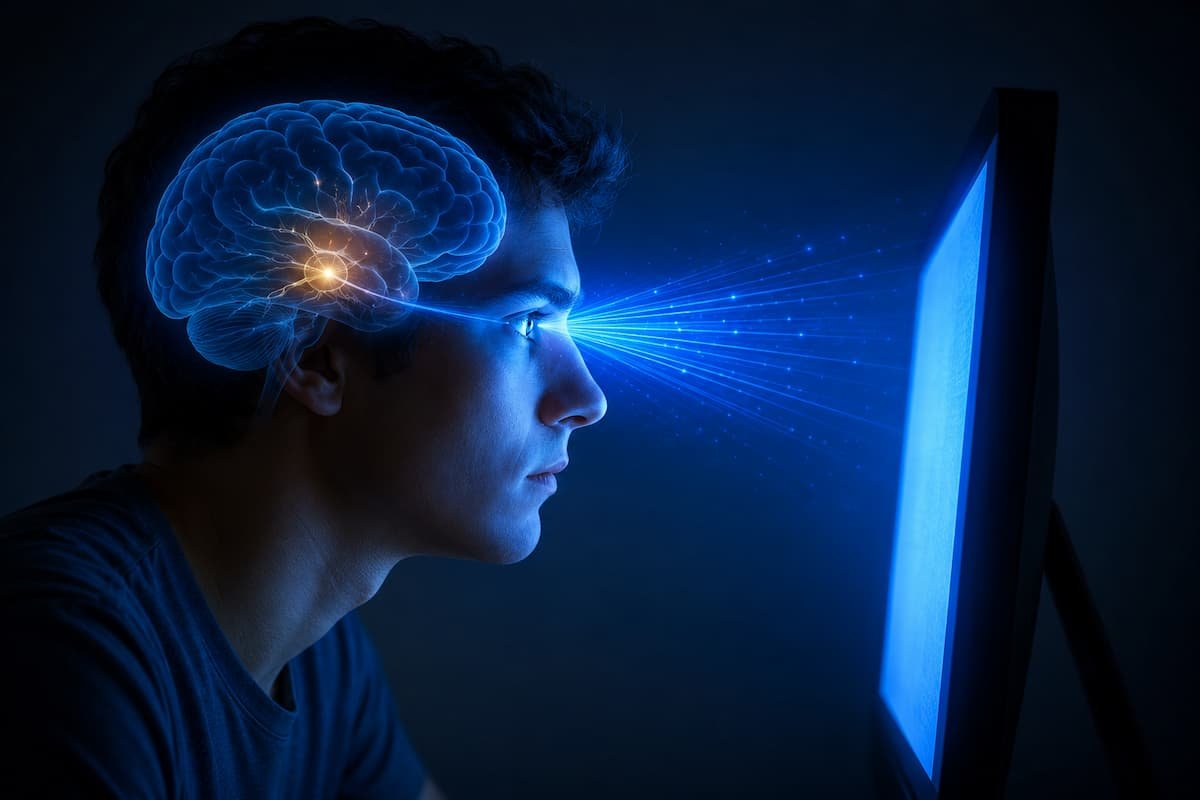
It is 11:30 PM. You tell yourself you will check one last notification. Thirty minutes later, you are still scrolling. Your eyes feel fine. Your brain, however, has been hijacked. That small screen is flooding your retina with blue wavelengths that your ancient biology interprets as midday sun—and your brain obeys by keeping you wired.
This is not a willpower problem. It is a neuroscience problem. For most of human history, the only source of blue light was the sun. Our brains evolved to treat that specific wavelength as an unambiguous signal: daytime has arrived; stay awake and alert. Then we invented LEDs, smartphones, and tablets—and flooded our evenings with the exact signal our biology uses to distinguish noon from midnight.
The Third Light Sensor Nobody Talks About
For decades, scientists assumed that rods and cones — the photoreceptors responsible for vision — also handled the non-visual effects of light, like regulating sleep. That assumption collapsed in the early 2000s with the discovery of a completely separate light-sensing system in the eye.
Hidden among the roughly one million retinal ganglion cells are a small subset—about one to three percent—called intrinsically photosensitive retinal ganglion cells, or ipRGCs. These cells do not help you see images. They exist solely to detect light for biological timing. Inside each ipRGC is a photopigment called “melanopsin,” which absorbs light most efficiently at approximately 480 nanometers—squarely in the blue range of the visible spectrum.
Unlike rods and cones, which send visual information to the visual cortex, ipRGCs form their own dedicated neural highway — the retinohypothalamic tract — that projects straight to the suprachiasmatic nucleus (SCN), the brain’s master circadian clock. This means your brain receives two completely separate streams of light information: one for seeing, and one for timing your biology. Even people who are blind due to rod and cone damage can maintain normal circadian rhythms if their ipRGCs remain intact.
The melanopsin in these cells is uniquely suited for its job. It functions as a bistable pigment, meaning it can regenerate its light-sensitive form using long-wavelength light—a feature that allows ipRGCs to sustain their signaling for as long as light is present. This prolonged response is ideal for tracking ambient light levels over time, which is exactly what a circadian system needs.
How the Master Clock Gets Rewired
The suprachiasmatic nucleus sits in the hypothalamus, just above the optic chiasm, where the optic nerves cross. It is tiny — about the size of a grain of rice — yet it governs virtually every rhythmic process in your body. The SCN operates through an elegant molecular feedback loop involving clock genes like PER, CRY, CLOCK, and BMAL1, creating an internal rhythm of roughly 24.2 hours.
Left alone, this internal clock would drift. It needs a daily reset — a zeitgeber, or time-giver. Light is the most powerful zeitgeber known. When blue light hits melanopsin in your ipRGCs, those cells fire action potentials that race along the retinohypothalamic tract and dump glutamate onto SCN neurons. This triggers a signaling cascade—calcium influx, kinase activation, and CREB phosphorylation—that directly resets the molecular clock machinery.
The same light exposure has opposite effects depending on when it occurs. Morning blue light advances your clock (makes you want to sleep earlier), while evening blue light delays it (makes you want to sleep later). Midday light has minimal phase-shifting power. This is why that late-night scroll session is so destructive—it is hitting your brain at the exact circadian phase where light does the most damage to your sleep timing.
The Melatonin Shutdown
Here is where things get personal. The SCN does not produce melatonin itself. Instead, it orchestrates melatonin synthesis through a multi-synaptic relay: SCN → paraventricular nucleus → spinal cord → superior cervical ganglion → pineal gland. During darkness, the SCN allows this pathway to run freely, and your pineal gland pumps melatonin into your bloodstream. This is your body’s chemical night signal.
When evening blue light activates your ipRGCs, the SCN clamps down on this pathway within minutes. Norepinephrine release to the pineal is suppressed. The rate-limiting enzyme for melatonin synthesis, AANAT, is shut off. Your melatonin levels plummet.
Harvard researchers put hard numbers on this. In a controlled study comparing 6.5 hours of blue light exposure to equal-brightness green light, the blue light suppressed melatonin for about twice as long and shifted circadian rhythms by twice as much—three hours versus 1.5 hours.
Even more troubling: a study at the University of Toronto found that people wearing blue-light-blocking goggles under bright indoor light had melatonin levels similar to those sitting in dim light without goggles. This confirmed that blue wavelengths are the primary culprit in melatonin suppression, not light intensity alone.
Beyond Melatonin: The Direct Alertness Hack
The blue light story does not end with hormone suppression. Even if you somehow blocked melatonin entirely, blue light would still keep you awake through a parallel neural pathway that bypasses the SCN entirely.
ipRGCs send direct projections to brain regions that control arousal. They innervate the lateral hypothalamus, home to orexin/hypocretin neurons that are essential for maintaining consolidated wakefulness. They also project to the locus coeruleus, the brain’s main source of norepinephrine, and other monoaminergic arousal centers in the brainstem.
This means blue light does not just remove your sleep signal—it actively injects a wake signal. EEG studies have shown that blue light suppresses sleep-associated delta brainwaves and boosts alpha waves linked to alertness. Subjects exposed to blue light during working memory tasks showed quicker reaction times and fewer attention lapses compared to those under green light—but this enhanced alertness comes at a steep cost when it happens at night.
| Brain Region | Blue Light Effect | Result |
|---|---|---|
| Suprachiasmatic Nucleus (SCN) | Resets molecular clock; delays circadian phase | Later sleep onset, shifted body rhythms |
| Pineal Gland (via SCN relay) | Suppresses melatonin synthesis | Loss of chemical night signal |
| Lateral Hypothalamus | Activates orexin/hypocretin neurons | Increased wakefulness drive |
| Locus Coeruleus | Triggers norepinephrine release | Heightened arousal and alertness |
| Ventrolateral Preoptic Nucleus (VLPO) | Reduces GABAergic sleep-promoting activity | Weakened sleep pressure |
The 9 PM Tipping Point
Not all evening screen time is equally damaging. A 2025 study on adolescent athletes found that blue light exposure before 9:00 PM had minimal impact on sleep, while exposure from 9:00 PM to 10:30 PM — and especially from 10:30 PM to midnight — caused significant harm.
The data was stark. Compared to no exposure, blue light after 9:00 PM reduced total sleep time, increased sleep onset latency, and degraded next-day cognitive performance. Dart-throwing accuracy dropped. Selective attention scores fell. Movement duration slowed. The later the exposure, the worse the outcomes.
Researchers identified a “critical window” for melatonin suppression that opens roughly three hours before habitual bedtime. For someone who typically sleeps at midnight, this means 9:00 PM is when your brain becomes maximally vulnerable to blue light’s phase-delaying effects. This is not arbitrary — it aligns with your dim light melatonin onset (DLMO), the point when melatonin concentration begins its nightly rise under dim conditions.
Why Modern Lighting Makes It Worse
Here is the irony: the lighting technology we adopted for energy efficiency is precisely what is wrecking our sleep. Traditional incandescent bulbs produce a smooth spectrum with relatively little blue light. Modern white LEDs work differently. They use a blue pump diode (typically 450–490 nm) to excite a yellow phosphor. This creates a spectral power distribution with a sharp, high-energy peak that aligns almost perfectly with melanopsin’s sensitivity curve.
A 2026 study comparing lamp technologies found that cool-white LEDs produced melatonin suppression values comparable to smartphone displays. Warm-white LEDs, by contrast, offered a 3.4-fold reduction in melatonin suppression. The oldest technology — incandescent bulbs — had the least circadian impact. This means the shift from incandescent to LED lighting, while saving electricity, introduced a novel public health risk that our biology never evolved to handle.
What Actually Works (And What Does Not)
The market is flooded with blue light solutions—glasses, screen protectors, and apps. Let us separate evidence from marketing.
Blue light blocking glasses: The evidence is mixed and context-dependent. A 2023 Cochrane systematic review of 17 randomized controlled trials concluded that blue light glasses “probably make no difference” to eye strain or sleep quality for the general population. However, a 2026 study found that amber-tinted lenses (not clear coatings) reduced melatonin suppression by up to 99%. The key variable is how much blue light the lens actually blocks — most standard clear lenses with blue-light coatings only filter 10–25%, while amber lenses block significantly more.
Device night modes: These shift your screen toward warmer colors by reducing blue emission. They help, but only partially. Reducing screen brightness and using night mode together is more effective than either alone.
Tunable LED lamps: These are the most promising environmental solution. Lamps that shift from cool (high color temperature) during the day to warm (low color temperature) in the evening can reduce evening melatonin suppression to near-zero levels while maintaining useful illumination.
Practical Steps That Cost Nothing
If you want to stop blue light from tricking your brain, you do not need expensive gear. Here is what the research supports:
- Establish a device cutoff time. The data points to 9:00 PM as a practical threshold for most people on a conventional schedule. After this point, every minute of screen exposure measurably degrades sleep architecture.
- Dim your environment. Even typical living room light (under 200 lux) suppresses melatonin and shortens its production duration. Switch to warm, dim lighting after sunset.
- Use your device’s night mode properly. Enable it automatically at sunset, but also manually reduce brightness. A warm screen at full brightness still delivers significant blue light.
- Get morning sunlight. This is the flip side of the equation. Bright morning light anchors your circadian clock and makes you less sensitive to evening disruption. A 2026 University of Manchester study found that higher daytime light exposure improved reaction speeds by 7–10% and enhanced sustained attention.
- Consider amber lenses if you must work evenings. Only if they block a meaningful percentage of blue light — clear coatings are largely cosmetic.
FAQs
The Bottom Line
Your brain did not evolve for LED screens. It evolved for a world where blue light meant the sun was up, predators were visible, and sleep was a dangerous luxury. That ancient wiring is still running the show — and every evening, millions of people are unknowingly flipping the wrong neural switches.
The science is clear: blue light at night suppresses melatonin, delays your circadian clock, and directly activates brain arousal centers through ipRGC projections to the hypothalamus and brainstem. The effects are not imaginary. They are measurable in hormone assays, EEG recordings, and next-day cognitive tests.
The good news is that the solution is simple, free, and entirely within your control. Dim the lights. Put the phone down. Let your brain believe it is actually nighttime. After three million years of evolution, it still knows what to do — if we stop confusing it.
Sources and References
- Harvard Health Publishing. “Blue light has a dark side.” Harvard Medical School, July 24, 2024. https://www.health.harvard.edu/healthy-aging-and-longevity/blue-light-has-a-dark-side
- Didikoglu, A., et al. “Higher daylight exposure improves cognitive performance.” Communications Psychology, University of Manchester, January 12, 2026. https://www.manchester.ac.uk/about/news/higher-daylight-exposure-improves-cognitive-performance-study-finds/
- Souissi, M.A., et al. “Impact of evening blue light exposure timing on sleep, motor, and cognitive performance in young athletes with intermediate chronotype.” PMC, 2025. https://pmc.ncbi.nlm.nih.gov/articles/PMC12244376/
- Spandidos Publications. “Retinal light perception and biological rhythms.” Molecular Medicine Reports, April 1, 2025. https://www.spandidos-publications.com/10.3892/mmr.2025.13726
- MDPI. “The Effects of Light and the Circadian System on Rhythmic Brain Function.” International Journal of Molecular Sciences, March 3, 2022. https://www.mdpi.com/1422-0067/23/5/2778
- Hölker, I., et al. “The inner clock—Blue light sets the human rhythm.” PMC. https://pmc.ncbi.nlm.nih.gov/articles/PMC7065627/
- Nature Scientific Reports. “Home lighting, blue-light filtering, and their effects on melatonin suppression.” January 21, 2026. https://www.nature.com/articles/s41598-025-29882-7
- PMC. “Efficacy of blue-light blocking glasses on actigraphic sleep outcomes: a systematic review and meta-analysis of randomized controlled crossover trials.” https://pmc.ncbi.nlm.nih.gov/articles/PMC12668929/
- MindLab Neuroscience. “Blue Light, Melatonin, and the Suprachiasmatic Nucleus.” May 30, 2026. https://mindlabneuroscience.com/blue-light-melatonin-suprachiasmatic-nucleus/
- Dr. Kumar Discovery. “Light-Sensing Cells in Your Eyes Control Sleep.” October 22, 2025. https://drkumardiscovery.com/posts/intrinsically-photosensitive-retinal-ganglion-cells/

Aisha Patel is the main writer and editor at GameVolts, a site she built to make neuroscience and health research useful for everyday people. She covers sleep, digital wellness, beginner fitness, skin science, and productivity — always digging into the original studies rather than recycling headlines. Aisha started GameVolts because she kept finding wellness advice that contradicted itself and rarely linked to actual evidence. Her rule is simple: if she cannot explain the mechanism behind a claim, she does not publish it.