
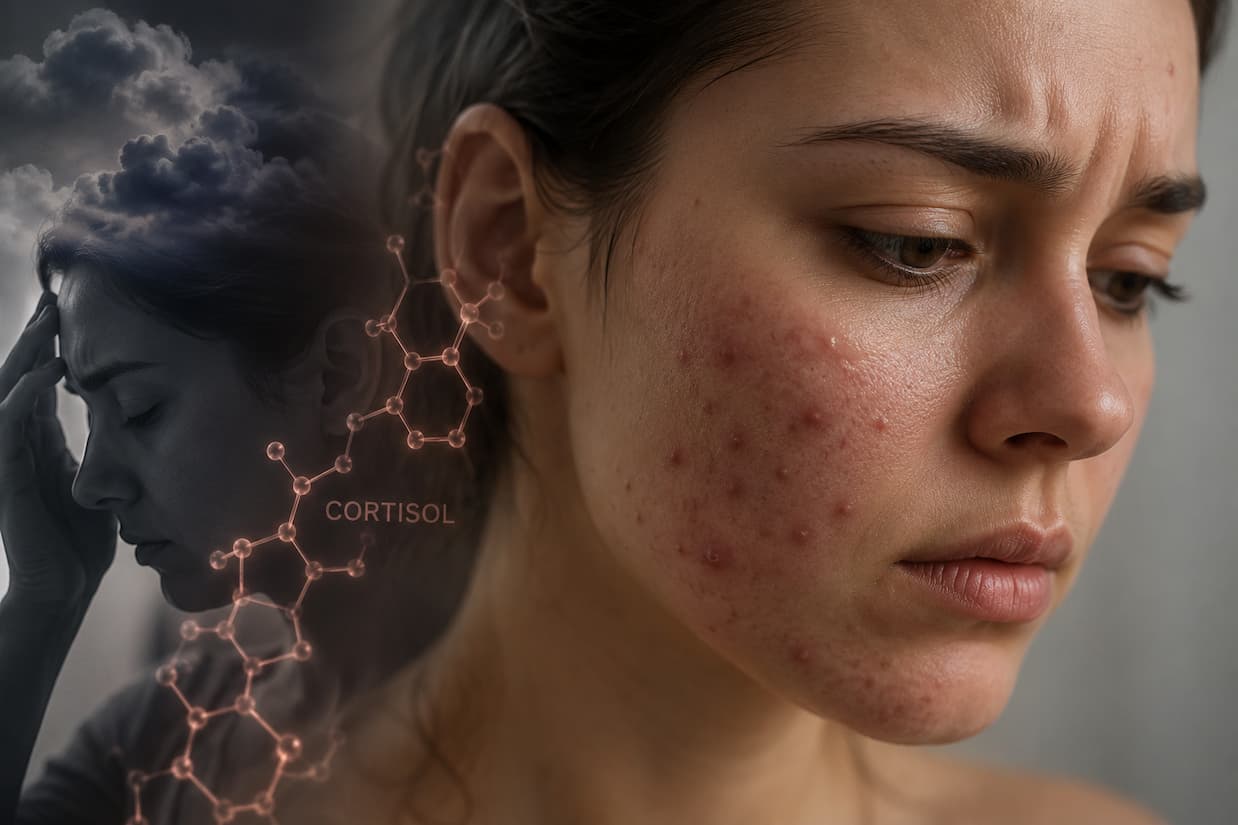
Your Face Is a Diary Your Stress Level Writes In
There is a particular kind of breakout that arrives uninvited, always at the worst possible moment. The morning of a presentation. The week of a wedding. The day after a sleepless night spent replaying conversations and calculating debts. It sits red, angry, and deep, unlike the surface whiteheads of the teenage years. It throbs slightly when you touch it, as if reminding you of its presence. You did not eat poorly. You did not skip your routine. Yet there it is, proof that something beyond your bathroom cabinet is steering your skin. That something is cortisol, and it has been leaving evidence on human faces since long before dermatology had a name for it.
Cortisol is a glucocorticoid hormone produced by your adrenal glands, perched atop your kidneys like tiny sentinels. In acute moments of danger, it floods your bloodstream, mobilizing glucose, sharpening focus, and suppressing non-essential functions so you can fight or flee. This system evolved for saber-toothed encounters, not for mortgage payments and inbox avalanches. Modern stress is chronic, low-grade, and unrelenting. Your body cannot distinguish between a predator and a deadline. The cortisol faucet drips continuously, and your skin pays the price in ways that are neither mysterious nor random. The connection is biochemical, measurable, and entirely real.
The Cortisol-Skin Highway: Stress signals the hypothalamus, which signals the pituitary, which signals the adrenal glands to release cortisol. This hormone reaches every organ, including skin, within minutes. There is no firewall. Your face is always listening.
How Cortisol Rewires Your Skin’s Daily Operations
Your skin operates on rhythms. Cell turnover, sebum production, barrier repair, and immune surveillance all follow circadian patterns regulated by hormones. Cortisol is one of the primary conductors of this orchestra, normally peaking in early morning to wake you up and declining through the day to let you sleep. Chronic stress shatters this rhythm. Cortisol stays elevated, or spikes unpredictably, and every skin function tied to its timing begins to falter.
Sebaceous glands, which produce the oil that lubricates and protects your skin, carry cortisol receptors. When stimulated, they increase sebum output. This alone does not cause acne, but it creates the oily environment where Cutibacterium acnes thrives. More oil means more food for bacteria, more clogged pores, and more inflammation when the immune system eventually responds. The breakout is not caused by oil alone. It is caused by the cascade that oil initiates when other stress-related factors are also present.
Cortisol also impairs wound healing and barrier repair. It suppresses the production of ceramides, cholesterol, and fatty acids that form the mortar between your skin cells. A compromised barrier leaks water, allowing irritants and pathogens to penetrate more easily. Your skin becomes simultaneously oilier and more vulnerable, a combination that seems contradictory until you understand the dual mechanisms at play. The oil is upregulated by cortisol. The barrier is downregulated by the same hormone. Your face becomes a battlefield where excess sebum meets weakened defenses.
| Skin Function | Normal Regulation | Under Chronic Cortisol | Visible Result |
|---|---|---|---|
| Sebum production | Circadian rhythm, moderate output | Elevated, irregular spikes | Oily shine, enlarged pores, comedones |
| Barrier repair | Nightly ceramide synthesis | Slowed, incomplete lipid production | Redness, sensitivity, dehydration |
| Immune response | Targeted, self-limiting inflammation | Delayed then exaggerated, chronic | Persistent redness, swollen acne, slow healing |
| Cell turnover | 28-day cycle, orderly shedding | Disrupted, uneven maturation | Dullness, rough texture, clogged pores |
| Collagen synthesis | Steady production, nightly repair | Suppressed, degraded by matrix metalloproteinases | Fine lines, loss of elasticity, and premature aging |
The Inflammation Loop That Keeps Feeding Itself
Stress triggers inflammation. Inflammation triggers more stress. This is not a metaphor. It is neuroimmunology. When cortisol remains elevated, your immune cells develop resistance to its anti-inflammatory signals. They stop listening to the hormone that is supposed to calm them down. Instead, they release pro-inflammatory cytokines like interleukin-6 and tumor necrosis factor-alpha into your bloodstream. These molecules reach your skin and activate mast cells, the granule-filled sentinels that release histamine and other inflammatory mediators.
The result is skin that overreacts to everything. A product you have used for months suddenly stings. A minor blemish balloons into a cystic lesion. A gentle touch leaves a red mark that lingers for hours. This is not sensitivity in the traditional sense. It is inflammation without brakes, driven by a nervous system that cannot distinguish between genuine threats and psychological pressure. Your skin becomes a mirror of your internal state, and the reflection is not flattering.
There is also a gut-skin axis that stress disrupts. Cortisol alters gut motility, increases intestinal permeability, and shifts the microbiome toward inflammatory species. These changes increase systemic inflammation and can trigger or worsen skin conditions including acne, eczema, and psoriasis. The gut and skin are embryologically derived from the same tissue layer, and they remain in constant conversation through immune signaling. When your gut is stressed, your skin hears about it.
Why Some Breakouts Are Unmistakably Stress-Driven
Not every pimple is a stress signal. But stress breakouts have a signature that experienced observers learn to recognize. They tend to appear along the jawline, chin, and lower cheeks, areas with higher concentrations of hormone-responsive sebaceous glands. They are often deep, nodular, and painful rather than superficial. They arrive in clusters rather than isolation, suggesting a systemic trigger rather than a localized pore blockage. They coincide with identifiable stressors, though the lag time of days to weeks can obscure the connection.
Women often notice this pattern around menstrual cycles when cortisol and sex hormones interact. The week before a period is already progesterone-dominant, which stimulates sebum production. Add work deadlines, relationship tension, or sleep deprivation, and the cortisol surge amplifies everything. The result is predictable, cyclical, and devastatingly timed. Men are not exempt. Testosterone and cortisol have their own synergistic effects on sebaceous glands, and modern work culture creates chronic stress environments that affect all genders equally.
The lag between stress and breakout is typically 3-7 days. This delay makes the connection easy to miss. You blame the pizza you ate Sunday, not the argument you had Wednesday. Your skin remembers longer than your calendar.
Breaking the Cycle: What Actually Helps
Topical treatments for stress breakouts are necessary but insufficient. You can suppress sebum, kill bacteria, and reduce inflammation with products, but if the cortisol faucet keeps dripping, the problem regenerates. Effective management requires addressing both the skin symptoms and the stress source. This is not a wellness platitude. It is a biological necessity.
Sleep as Intervention
Sleep deprivation raises cortisol and disrupts the nocturnal repair processes that skin depends on. During deep sleep, growth hormone peaks, stimulating cell regeneration and collagen synthesis. Cortisol is supposed to be at its lowest, allowing these processes to proceed uninterrupted. Even one night of poor sleep elevates cortisol the following evening, creating a cascade that can persist for days. Prioritizing sleep is not luxury. It is the single most effective stress-skin intervention available, and it costs nothing.
Physical Activity
Exercise initially raises cortisol, which sounds counterproductive. But regular moderate exercise improves cortisol regulation over time, enhancing the feedback loops that shut down stress responses when threats pass. It also improves circulation, delivering nutrients to skin and carrying away inflammatory byproducts. The key is moderation. Overtraining creates chronic cortisol elevation that mimics the stress you are trying to escape. Thirty to forty-five minutes of moderate activity most days is the sweet spot.
Mindfulness and Breath Work
These practices activate the parasympathetic nervous system, the branch that counteracts cortisol-driven sympathetic arousal. Slow diaphragmatic breathing, even for five minutes, measurably reduces cortisol levels. Mindfulness meditation changes brain structure over time, increasing prefrontal cortex regulation of emotional responses. You do not need to become a monk. Consistent brief practice outperforms occasional intensive retreats. Your skin responds to the cumulative effect of daily calm, not the intensity of isolated experiences.
Topical Adaptations
When stress is unavoidable, adjust your skincare to compensate. Simplify your routine to reduce the burden on a compromised barrier. Increase anti-inflammatory ingredients like niacinamide, green tea extract, and centella asiatica. Avoid introducing new actives during high-stress periods, as sensitized skin is more likely to react. Consider a non-comedogenic facial oil to support barrier repair without clogging pores. And never skip sunscreen, because stressed skin is more photosensitive and more prone to post-inflammatory hyperpigmentation when breakouts heal.
When to Seek Professional Help
Stress-related skin changes can become self-perpetuating. The visible evidence of stress creates more stress, which worsens the skin, which creates more stress. Breaking this loop alone is sometimes impossible, and seeking help is not a weakness. It is a strategy.
- Dermatologists can prescribe topical or oral medications to control severe stress-driven acne while you address underlying causes
- Mental health professionals can provide cognitive behavioral therapy, which has been shown to reduce cortisol levels and improve stress-related skin conditions
- Endocrinologists can evaluate for underlying hormonal imbalances that amplify cortisol’s effects
- Integrative medicine practitioners can assess adrenal function and guide targeted stress-reduction protocols
There is no shame in treating the symptom while working on the cause. Dermatology and psychology are not competing approaches. They are complementary tools for a problem that operates on both biological and psychological levels simultaneously.
Related Articles
- How Your Skin Renews Itself Every 28 Days — Stress disrupts the natural turnover cycle; understanding it helps set realistic recovery timelines.
- Hyperpigmentation: The Real Science Behind Dark Spots — Stress breakouts often leave lasting pigment marks; this explains why and how to prevent them.
- Oily, Dry, or Combination: Skin Type Myths Debunked — Stress can shift your skin’s behavior dramatically, making static labels useless.
- What Drinking Water Actually Does for Your Skin — Hydration supports barrier recovery, but only if you understand what water actually accomplishes.
- The One Ingredient Sensitive Skin Reacts to Most — Stressed skin becomes reactive; this helps you identify hidden triggers in your routine.
Sources and References
- Chen Y, Lyga J. “Brain-skin connection: stress, inflammation and skin aging.” Inflammation & Allergy Drug Targets, 2014. This review synthesizes the neuroendocrine pathways connecting psychological stress to skin inflammation and accelerated aging.
- Zouboulis CC, Bohm M. “Neuroendocrine regulation of sebocytes: a pathogenetic link between stress and acne.” Experimental Dermatology, 2004. This study establishes the presence of cortisol receptors on sebaceous glands and demonstrates stress-induced sebum upregulation.
- Arck P, Slominski A, Theoharides TC, Peters EM, Paus R. “Neuroimmunology of stress: skin takes center stage.” Journal of Investigative Dermatology, 2006. This comprehensive review positions skin as a primary interface between the nervous system and immune function under stress.
- Garg A, Chren MM, Sands LP, et al. “Psychological stress perturbs epidermal permeability barrier homeostasis: implications for the pathogenesis of stress-associated skin disorders.” Archives of Dermatology, 2001. This landmark study demonstrates that acute psychological stress measurably impairs skin barrier recovery in humans.
- Chiu A, Chon SY, Kimball AB. “The response of skin disease to stress: changes in the severity of acne vulgaris as affected by examination stress.” Archives of Dermatology, 2003. This prospective study correlates examination stress with acne severity in medical students, quantifying the stress-acne relationship.
- Abedini R, Farshi S, Joharchi K, Robati RM. “Corticotropin-releasing hormone receptor expression in normal and psoriatic skin.” Acta Dermato-Venereologica, 2010. This research identifies stress hormone receptors in skin tissue and their altered expression in inflammatory skin disease.
- Kimyai-Asadi A, Usman A. “The role of psychological stress in skin disease.” Journal of Cutaneous Medicine and Surgery, 2001. This clinical review examines the evidence for stress as a trigger and exacerbating factor across multiple dermatological conditions.
This article was written to bridge the gap between dermatology and psychology, two fields that often treat stress-skin connections as peripheral rather than central. The evidence is robust and growing. Your face is not separate from your mind. It is where your mind becomes visible.

Aisha Patel is the main writer and editor at GameVolts, a site she built to make neuroscience and health research useful for everyday people. She covers sleep, digital wellness, beginner fitness, skin science, and productivity — always digging into the original studies rather than recycling headlines. Aisha started GameVolts because she kept finding wellness advice that contradicted itself and rarely linked to actual evidence. Her rule is simple: if she cannot explain the mechanism behind a claim, she does not publish it.