
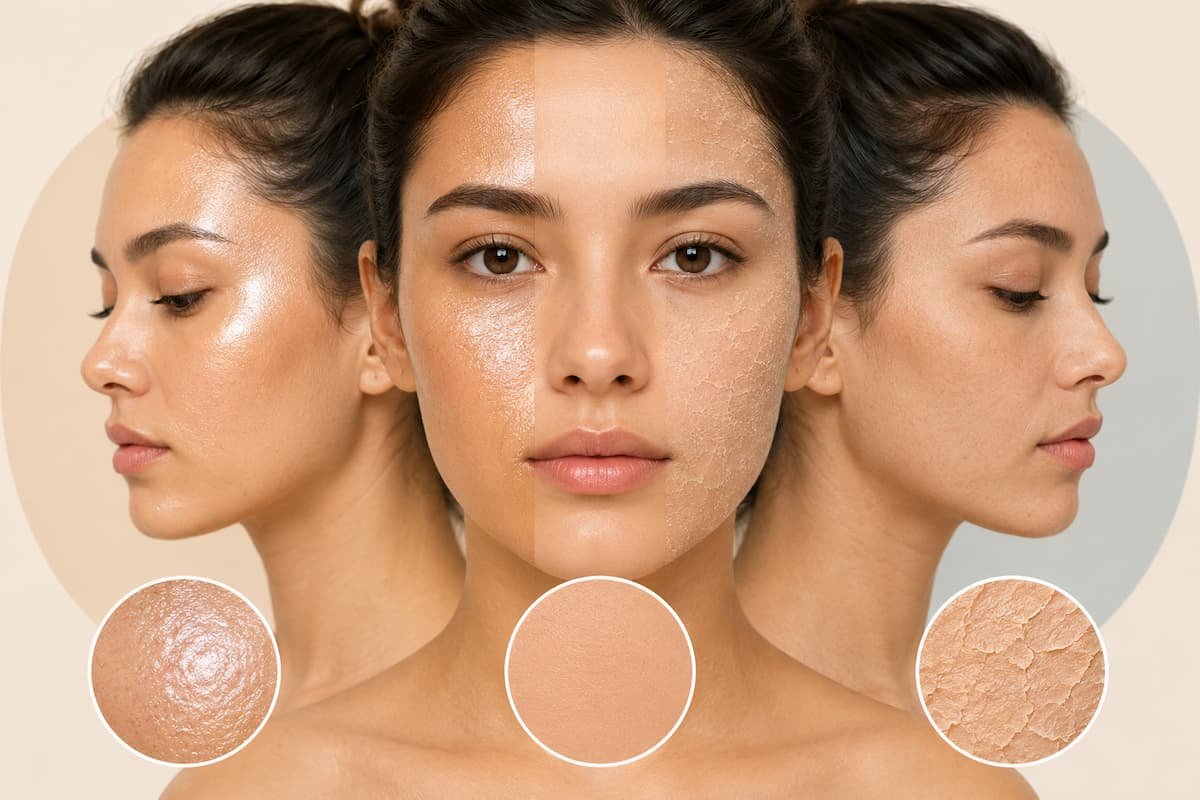
Walk into any beauty store and the first question you hear is about your skin type. Oily, dry, combination, or sensitive. These labels are treated like permanent personality traits, stamped onto your face forever. But here is what the skincare industry does not advertise loudly. Skin type is not a fixed identity. It is a snapshot of how your skin is behaving right now, under current conditions, with your current habits. Dermatologists have known this for years, yet the myth of unchanging skin types persists because it sells products. If you believe you are permanently oily, you will buy oil-free everything for life. If you think you are dry, you will load up on heavy creams regardless of the season. The truth is far more interesting and far more useful than any label on a product bottle.
Your skin changes with the weather, your diet, your stress levels, your age, and even the time of month. A person who is oily in humid July can be flaky and tight in dry January. Someone who battled acne in their twenties might find their skin becomes dehydrated and sensitive in their forties. The categories we use are not entirely useless, but they are gross oversimplifications that often lead people down the wrong path. Understanding the real factors behind how your skin behaves will save you money, reduce frustration, and help you build a routine that actually responds to what your skin needs today, not what a quiz told you five years ago.
Quick Reality Check: Studies show that up to 50% of people misidentify their own skin type when asked. The labels are confusing because they describe symptoms, not causes.
The Problem With Putting Skin in Boxes
The traditional four-category system was developed decades ago, primarily as a marketing tool to help consumers choose products off shelves. It was never meant to be a medical classification. Dermatologists do not diagnose skin types in clinics. They assess skin conditions, barrier function, hydration levels, and sebum production. These are measurable factors that change over time. Sebum production alone can vary by up to 40% throughout a single day depending on hormone fluctuations, stress, and environmental exposure. Yet we are expected to pick one label and stick with it for years.
The combination skin label is perhaps the most misleading of all. Nearly everyone has an oilier T-zone and slightly drier cheeks because the face has more sebaceous glands in the center and fewer toward the edges. This is normal facial anatomy, not a special skin type. Calling it combination skin makes it sound like a problem that needs a complicated multi-product solution. In reality, most faces have natural variation across different zones. The real question is whether that variation is causing actual problems like breakouts, tightness, or irritation. If it is not, you do not need to fix it. If it is, the solution lies in understanding why those zones are behaving differently, not in slapping a label on your forehead.
What Actually Determines How Your Skin Behaves
Sebum production is controlled by hormones, particularly androgens like testosterone. This is why teenagers often experience oily skin and acne during puberty when hormone levels spike. It is also why many women notice oilier skin during ovulation and drier skin during menstruation when hormone levels shift. Birth control pills, pregnancy, and menopause all create dramatic changes in sebum production. A woman who was oily her entire life might find herself struggling with dryness after menopause because estrogen levels drop and sebaceous glands slow down. This is not a change in skin type. It is a change in biology that requires a different approach.
Barrier function is another critical factor that the simple type labels ignore. Your skin barrier is made of lipids that hold cells together and prevent water loss. When this barrier is damaged, water escapes and skin feels dry, tight, and sensitive. But this is not necessarily true dry skin. It is dehydrated skin, and the distinction matters enormously. True dry skin produces less sebum naturally. Dehydrated skin lacks water because the barrier is compromised, but it might still produce plenty of oil. Many people with oily skin actually have dehydrated skin underneath because they have stripped their barrier with harsh cleansers and acids. They keep buying products for oily skin, which makes the dehydration worse, and they never understand why their face is both oily and flaky at the same time.
Dehydrated skin often overproduces oil to compensate for water loss. Treating it with oil-free products can trap you in a cycle where your skin gets oilier and more uncomfortable over time.
How the Seasons Change Everything
Environmental factors play a massive role in skin behavior, yet skin type labels pretend these do not exist. Winter air holds less moisture, and indoor heating strips humidity from your environment. This causes increased transepidermal water loss, meaning your skin loses water to the dry air around it. The result is tightness, flaking, and sensitivity that many people mistake for a sudden shift to dry skin. They switch to heavy creams and rich cleansers, which might help temporarily. But when spring arrives and humidity rises, those same heavy products can clog pores and cause breakouts. The person then declares they have combination skin, when really they just needed to adjust their routine for the season.
Summer brings its own challenges. Heat increases blood flow and sweat production, which can make skin look oilier and more congested. UV exposure damages the skin barrier and triggers inflammation, leading to redness and sensitivity that might be mislabeled as sensitive skin. Air conditioning, while cooling, also dehumidifies the air and can cause dehydration similar to winter heating. The point is that your skin is constantly responding to its environment. A label assigned in one season might be completely irrelevant in another. The smartest approach is to pay attention to how your skin feels and looks right now, and adjust your products accordingly rather than clinging to a category you selected years ago.
The Sensitive Skin Confusion
Sensitive skin is not technically a skin type at all. It is a condition, and it is becoming more common for reasons that have nothing to do with genetics. The modern skincare routine is often an assault on the skin barrier. Multiple active ingredients layered daily, frequent exfoliation, strong retinoids, and harsh cleansers all strip away the protective lipids that keep skin resilient. When the barrier is damaged, everything stings, everything turns red, and everything causes a reaction. This is not because the skin was born sensitive. It is because the skin has been sensitized by over-treatment.
True genetic sensitivity does exist, but it is relatively rare. It usually involves conditions like rosacea, eczema, or allergic contact dermatitis that require medical management. Most people who call themselves sensitive are actually dealing with a compromised barrier that could be repaired with a simplified, gentle routine. The irony is that the skincare industry sells more products to sensitive skin sufferers, creating a cycle where more products cause more sensitivity, which drives more product purchases. Breaking out of this cycle requires courage. It means stripping your routine down to the basics, giving your barrier weeks to recover, and resisting the urge to add new treatments every time you see an advertisement.
Building a Routine That Listens Instead of Labels
Instead of asking what skin type you have, ask better questions. Does my skin feel tight after cleansing? If yes, your cleanser might be too harsh regardless of whether you think you are oily. Do I get shiny by midday, or does my makeup slide off? This could indicate high sebum production, but it could also indicate dehydration causing an overproduction of oil. Are my cheeks rough and flaky while my nose is smooth? This is normal variation, not necessarily a combination skin crisis. Do products often sting or cause redness? This suggests barrier compromise that needs repair before any active treatment.
A flexible routine starts with a gentle cleanser that removes dirt without stripping lipids. Follow with a moisturizer that supports barrier repair using ingredients like ceramides, cholesterol, and fatty acids. These are the building blocks of healthy skin, and everyone needs them regardless of oil production. Sunscreen is non-negotiable for all skin because UV damage affects oil production, barrier function, and aging equally. From this foundation, you can add targeted treatments based on current concerns. A salicylic acid product a few times a week if pores are congested. A hyaluronic acid serum if hydration is lacking. A niacinamide product if redness and oiliness are both present. The key is adding one thing at a time, observing for several weeks, and adjusting based on response rather than predetermined labels.
| What You Might Notice | What It Likely Means | What to Try |
|---|---|---|
| Tightness after washing | Cleanser is too harsh or pH is wrong | Switch to a gentle, non-foaming cleanser |
| Shiny by midday, but flaky too | Dehydrated skin overproducing oil | Add a lightweight hydrating serum, not more oil control |
| Redness with most products | Barrier is compromised and sensitized | Strip routine to basics for 4-6 weeks |
| Cheeks drier than T-zone | Normal facial anatomy, not a problem | Use slightly richer moisturizer on dry areas only |
| Sudden change with weather | Environmental response, not new skin type | Adjust hydration level seasonally |
When Labels Might Actually Help
There is one situation where skin type labels serve a useful purpose. In clinical dermatology, understanding baseline sebum production can help guide treatment choices for conditions like acne. Someone with naturally high sebum production might benefit from different topical treatments than someone with low sebum production. But even here, dermatologists look at the whole picture. They consider hormone levels, barrier function, medical history, and current medications. They do not hand a patient a quiz and send them to the skincare aisle.
For the average person trying to build a healthy routine, the labels create more problems than they solve. They encourage rigid thinking, unnecessary product accumulation, and frustration when the promised miracle for oily skin does not work. The most important skill you can develop is observation. Learn to read your skin each morning. Notice how it responds to new products over several weeks. Accept that what works in August might need tweaking by November. This approach requires more attention than a simple label, but it yields far better results. Your skin is a dynamic organ, not a static category. Treat it that way, and it will reward you with resilience you never thought possible.
Bottom Line
Skin type is a starting point, not a life sentence. Pay attention to how your skin behaves today, protect your barrier, and adjust with the seasons. The best routine is the one that adapts with you.
Related Articles
Understanding how your skin naturally renews itself can help you make better decisions about any routine. Read How Your Skin Renews Itself Every 28 Days to learn why patience matters more than product switching.
If you have noticed dark spots that seem to worsen regardless of your skin type, our article Hyperpigmentation: The Real Science Behind Dark Spots explains the biological mechanisms behind discoloration and why some treatments work better than others.
Stress affects every aspect of skin behavior, from oil production to barrier repair. Discover the connection in Stress Breakouts Are Real — Cortisol Leaves Evidence on Your Face.
For those wondering if their elaborate multi-step routine is actually helping, Your 10-Step Skincare Routine Might Be Doing More Harm Than Good offers a fresh perspective on simplification.
Hydration plays a role in every skin condition, not just dry skin. Learn the facts in What Drinking Water Actually Does for Your Skin.
Sources and References
Youn JI, Na JI, Choi SY, Huh CH, Park KC. “Regional and seasonal variations in facial sebum secretions: a proposal for the definition of combination skin.” Skin Research and Technology, 2005. This study demonstrates that combination skin characteristics are largely normal anatomical variations rather than a distinct skin type.
Purnamawati S, Indrastuti N, Danarti R, Saefudin T. “The role of moisturizers in addressing various kinds of dermatitis: a review.” Clinical Medicine & Research, 2017. This review discusses the importance of barrier repair and how misidentification of skin conditions leads to inappropriate treatment.
Draelos ZD. “The science behind skin care: moisturizers.” Journal of Cosmetic Dermatology, 2018. This article explains the difference between dry skin and dehydrated skin, and why the distinction matters for product selection.
Thiboutot D. “Regulation of human sebaceous glands.” Journal of Investigative Dermatology, 2004. This paper details how hormonal fluctuations control sebum production and why skin oiliness changes throughout life stages.
Leveque JL. “EEMCO guidance for the assessment of skin topography.” European Journal of Dermatology, 1999. This guidance document discusses how environmental factors like humidity and temperature alter skin surface properties and barrier function.
Sethi A, Kaur T, Malhotra SK, Gambhir ML. “Moisturizers: the slippery road.” Indian Journal of Dermatology, 2016. This review covers how overuse of products and incorrect skin type diagnosis contribute to sensitive skin conditions.
About this article: This piece was created to challenge common skincare misconceptions and help readers develop a more flexible, observation-based approach to their routines. The information is intended for general education and does not replace personalized advice from a dermatologist or licensed skincare professional.

Aisha Patel is the main writer and editor at GameVolts, a site she built to make neuroscience and health research useful for everyday people. She covers sleep, digital wellness, beginner fitness, skin science, and productivity — always digging into the original studies rather than recycling headlines. Aisha started GameVolts because she kept finding wellness advice that contradicted itself and rarely linked to actual evidence. Her rule is simple: if she cannot explain the mechanism behind a claim, she does not publish it.