Turns out, there is. And the science behind it is far more fascinating than I expected.
Why Your Brain Treats Paper and Pixels Differently
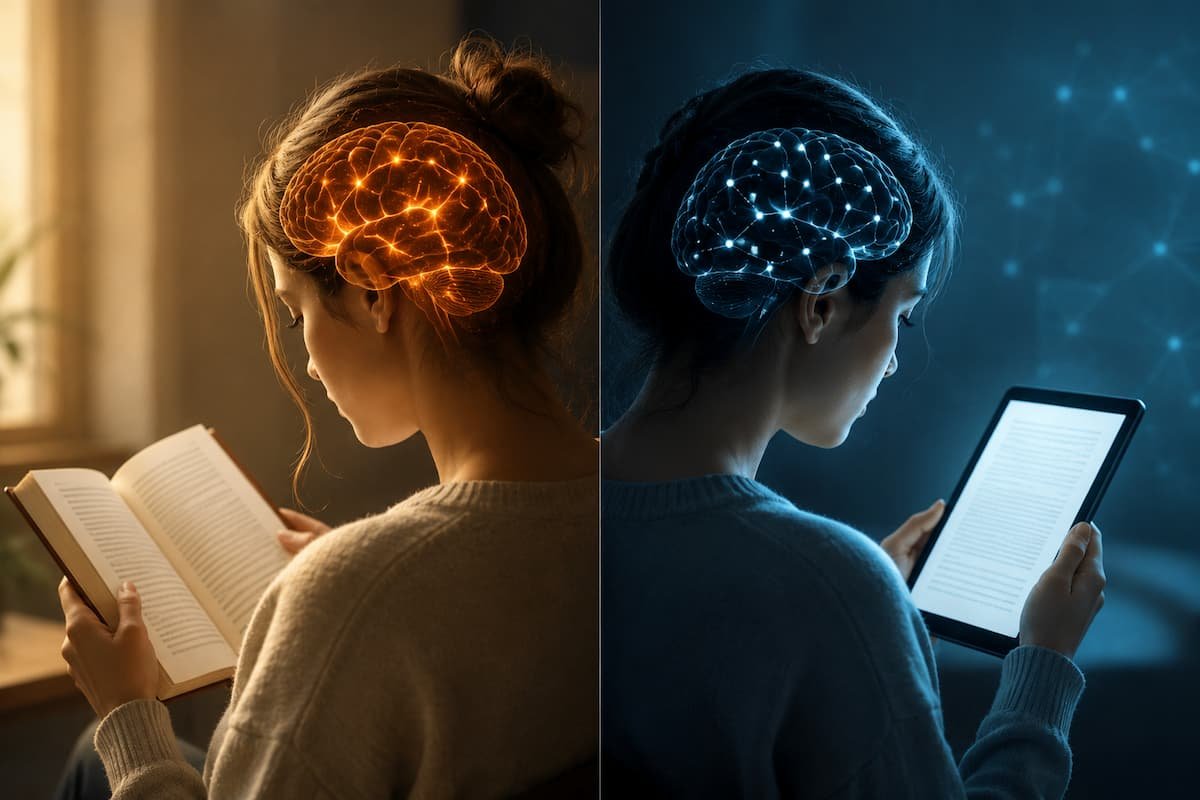
We tend to think of reading as a single, unified activity. You look at words, you understand them, and you store the information. But neuroscientists have discovered that the medium itself—the physical object in your hands versus the glowing rectangle—fundamentally changes how your brain encodes and retains information.
A groundbreaking 2024 meta-analysis of 49 studies confirmed what many of us suspected: students who read on paper consistently scored higher on comprehension tests than those reading the same material on screens. Researchers have even coined a term for this phenomenon: the “screen inferiority effect.”
But why? The answer lies in how our brains construct meaning from physical space.
The Cognitive Map You Didn’t Know You Were Building
When you read a physical book, your brain isn’t just processing words. It’s building a spatial memory map. You subconsciously remember that a crucial detail was on the left-hand page, about two-thirds of the way down. You recall that the plot twist happened roughly halfway through, when the book felt noticeably heavier in your right hand. These tactile and spatial cues act as anchors for your memory.
Digital text, by contrast, is fluid. When you scroll, the words move. The “location” of information is never fixed. As one researcher put it, trying to create a cognitive map of a scrolling screen is like trying to draw a map of a city where the buildings keep moving around. Your brain expends extra energy just trying to keep track of where things are, leaving less capacity for actually understanding the content.
What Brain Scans Actually Reveal
Modern neuroscience has given us a window into this process. In a May 2024 study from Columbia University, researchers had children read passages on both paper and screens while wearing electrode nets to measure brain activity. The results were striking.
When children read on paper, their brains showed more power in high-frequency brainwaves associated with concentration and deep processing. When they read on screens, their brains produced more low-frequency activity—the same patterns linked to mind-wandering and attention difficulties.
Even more telling was a 2024 University of Tokyo study using manga (visual stories). Readers who started on paper showed reduced activation in frontal brain regions when later recalling the story. Why? Because the paper version had already done some of the organizational work for them. The physical pages provided stable spatial cues, allowing their brains to integrate the narrative with less effort. Screen readers had to work harder to achieve the same understanding.
The Three Hidden Costs of Screen Reading
Based on the research, screen reading imposes three specific cognitive costs that paper avoids:
- Cognitive Overload: The brain must constantly manage scrolling, brightness adjustments, and the lack of fixed spatial references. This multitasking drains mental resources.
- Visual and Mental Fatigue: LED screens flicker subtly and emit blue light. Studies show digital readers experience 53% higher rates of eye strain and cognitive fatigue compared to print readers. Headaches, dry eyes, and difficulty maintaining focus are common complaints.
- The Skimming Tendency: Digital environments train us to scan and jump. We hunt for keywords rather than following linear arguments. While this works for finding a quick fact, it undermines deep comprehension of complex topics.
Speed vs. Understanding: The Trade-Off
Here’s where it gets counterintuitive. Research shows we actually read faster on screens—about 20 words per minute faster on average. But faster isn’t better. That increased speed comes from skimming, not deeper processing.
In controlled experiments where reading speed was held constant between paper and screen, comprehension differences remained. This tells us the medium itself—not just our behavior—changes how we process text. The screen encourages a shallow processing mode, even when we try to focus.
| Factor | Paper Reading | Screen Reading |
|---|---|---|
| Comprehension Score | Higher (avg. 8.1/10) | Lower (avg. 6.5/10) |
| 24-Hour Retention | 22% better recall | Faster forgetting |
| Reading Speed | ~240 words/minute | ~260 words/minute |
| Eye Strain/Fatigue | Minimal | 53% higher incidence |
| Distractions per Session | ~1.8 interruptions | ~4.6 interruptions |
| Engagement Level | Higher (7.3/10) | Lower (5.8/10) |
| Spatial Memory Cues | Strong (fixed pages) | Weak (scrolling text) |
When Screens Actually Work (And When They Don’t)
I’m not suggesting we abandon digital reading entirely. That would be impractical and ignore the genuine benefits of technology. Screens excel at:
- Quickly searching for specific facts or definitions
- Reading short news updates or brief emails
- Accessing interactive content with glossaries or embedded media
- Portability when traveling light
However, research consistently shows that for deep reading—understanding complex arguments, retaining detailed information, or following intricate narratives—paper maintains a clear advantage. The longer and more complex the text, the more pronounced this advantage becomes.
Practical Strategies for Better Reading
Given what we know about brain processing, here are practical steps you can take immediately:
- Match the medium to the task: Use print for deep study, complex articles, or anything you need to remember long-term. Use screens for quick reference or leisure browsing.
- Take handwritten notes: If you must read on screen, handwriting key points activates motor memory and improves retention significantly more than typing.
- Eliminate digital distractions: Put your phone in another room. Turn off notifications. Full-screen your reading app. Every interruption fragments your attention and forces your brain to rebuild its cognitive map.
- Use print for important material: If you’re studying for an exam, learning a new skill, or reviewing a critical work document, print it out. The spatial and tactile benefits are worth the paper.
- Take visual breaks: If screen reading is unavoidable, follow the 20-20-20 rule: every 20 minutes, look at something 20 feet away for 20 seconds. This reduces eye strain and cognitive fatigue.
The Bottom Line: Respect Your Brain’s Preferences
Your brain didn’t evolve to process glowing rectangles. It evolved to interact with physical objects in three-dimensional space. When we read on paper, we engage multiple senses—touch, sight, even smell—and recruit brain regions associated with spatial memory and emotional processing. This multi-sensory engagement creates richer, more durable memories.
Screen reading isn’t “bad.” It’s a different cognitive mode optimized for speed and scanning rather than depth and retention. The problem arises when we use screens for tasks that require deep processing, then wonder why we can’t remember what we read.
Quick Summary: Key Takeaways
- Paper reading activates deeper brain processing and better concentration patterns.
- Physical books provide spatial and tactile cues that strengthen memory.
- Screen reading is faster but leads to more skimming and lower retention.
- Digital readers experience significantly more eye strain and cognitive fatigue.
- Choose paper for complex, important, or lengthy material; use screens for quick reference.
The next time you pick up a book and feel that sense of calm focus wash over you, know that it’s not just nostalgia. It’s your brain breathing a sigh of relief, finally able to process information the way it was designed to. Sometimes, the old ways aren’t just romantic—they’re neurologically superior.

Aisha Patel is the main writer and editor at GameVolts, a site she built to make neuroscience and health research useful for everyday people. She covers sleep, digital wellness, beginner fitness, skin science, and productivity — always digging into the original studies rather than recycling headlines. Aisha started GameVolts because she kept finding wellness advice that contradicted itself and rarely linked to actual evidence. Her rule is simple: if she cannot explain the mechanism behind a claim, she does not publish it.