
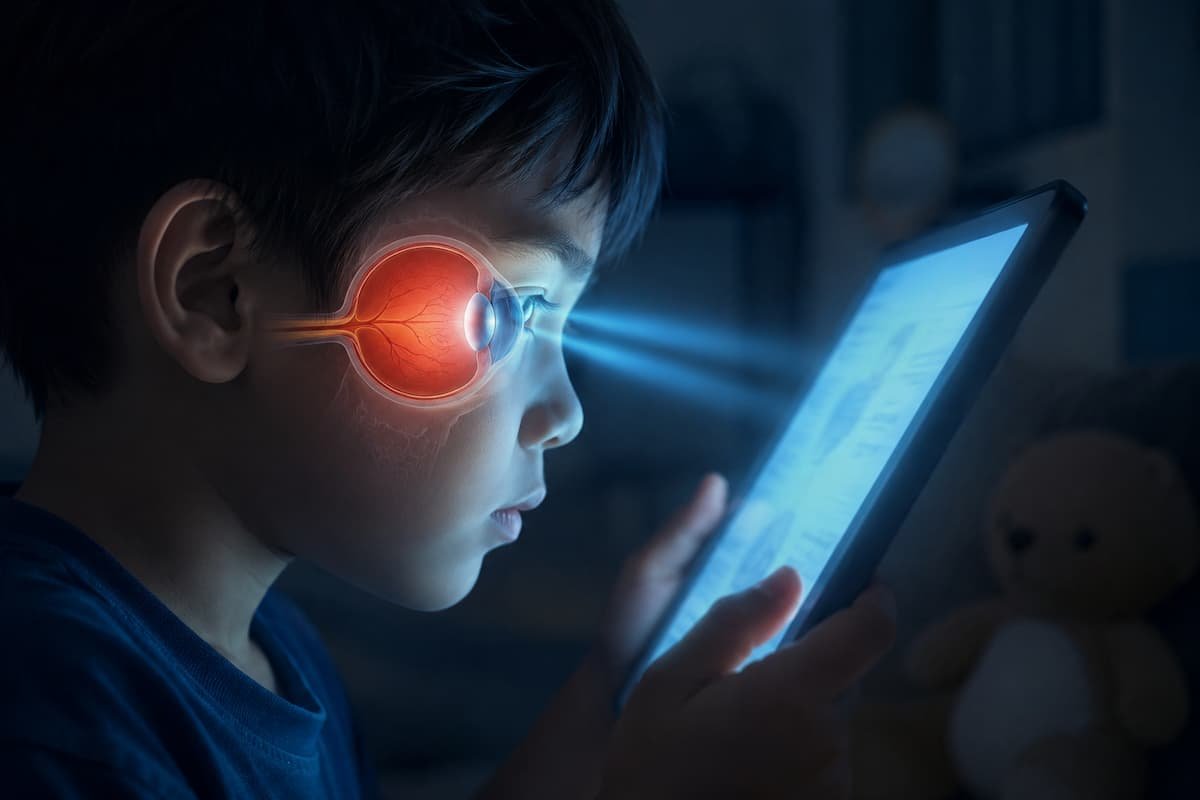
I still remember the first time my five-year-old nephew picked up a tablet and navigated to his favorite cartoon with more precision than I could manage. It was adorable—and slightly terrifying. Within minutes, he was glued to the screen, barely blinking, completely unaware of the world around him. As a parent, aunt, uncle, or caregiver, you have probably witnessed this exact scene. Screens have become the modern babysitter, teacher, and entertainer rolled into one glowing rectangle. But here is the uncomfortable truth we need to face: while we worry about what our children are watching, we rarely stop to consider what all that watching is doing to their eyes.
Children’s eyes are not miniature adult eyes. They are actively developing, stretching, and adjusting to the world. The structures inside a child’s eye are more sensitive, more pliable, and more vulnerable to environmental stressors. When we hand a child a screen, we are not just occupying their attention—we are reshaping the very organs they use to see the world. The consequences are showing up in doctors’ offices everywhere, and the statistics are impossible to ignore.
The Myopia Epidemic Nobody Saw Coming
When I was growing up, wearing glasses was somewhat unusual. Today, walk into any classroom, and you will see a sea of tiny faces framed by plastic lenses. This is not a coincidence. Over the past three decades, childhood myopia—nearsightedness—has exploded globally. Researchers have linked this surge directly to lifestyle changes, and screen time sits at the top of the suspect list.
Here is what happens inside the eye: when a child stares at a screen held close to their face for hours, the eyeball elongates to focus on the near object. In children, this elongation can become permanent. The younger the child, the more dramatic the effect because their eyes are still growing. Studies have found that children spending more than three hours daily on screens are nearly four times more likely to develop myopia compared to those with one hour or less. For six- and seven-year-olds, the risk jumps even higher.
The cruel irony? All that indoor screen time replaces outdoor play, and natural sunlight actually helps protect against myopia. Sunlight triggers the release of dopamine in the retina, which slows eye growth. When kids trade sunshine for screens, they lose this natural defense mechanism. It is a double hit: the close-up work strains the eyes, and the lack of sunlight removes their protection.
Digital Eye Strain: The Hidden Fatigue
Have you ever noticed your child rubbing their eyes after a tablet session? Or complaining of headaches that seem to come out of nowhere? These are not excuses to avoid homework—they are real symptoms of digital eye strain, sometimes called computer vision syndrome.
Children experience this differently than adults. For one, they do not recognize the early signs of eye fatigue. They will keep playing or watching long past the point of discomfort. Second, they blink far less frequently when staring at screens—sometimes dropping from a normal 15-20 blinks per minute down to just 3-5. Less blinking means tears evaporate faster, leaving eyes dry, irritated, and vulnerable.
Common Symptoms of Digital Eye Strain in Children
- Dry or irritated eyes – Often accompanied by excessive rubbing or blinking
- Blurred or double vision – Usually temporary but recurring after screen sessions
- Headaches – Typically centered around the temples or behind the eyes
- Neck and shoulder pain – From poor posture while hunched over devices
- Difficulty concentrating – Eyes that tire quickly make reading and schoolwork harder
I have seen my own niece develop a persistent dry cough that turned out to be related to her screen posture—she was compressing her airway while lying on her stomach watching videos. The body and eyes are connected in ways we do not always anticipate.
The Blue Light Debate: What We Actually Know
Walk into any electronics store, and someone will try to sell you blue light-blocking glasses for your child. But here is the reality check: the American Academy of Ophthalmology states there is no scientific evidence that blue light from screens damages children’s eyes. None. Zero. The light from a digital screen is not like staring into a laser.
However—and this is important—blue light does suppress melatonin production. Melatonin is the hormone that tells our brains it is time to sleep. When children use screens before bed, the blue light tricks their brains into thinking it is still daytime. They take longer to fall asleep, sleep less deeply, and wake up groggy. Poor sleep then compounds eye strain because rested eyes recover better from daily stress.
So while blue light may not be burning holes in retinas, it is quietly sabotaging sleep cycles. And in the world of pediatric eye health, sleep matters enormously. Growth hormone is released during deep sleep, and that includes the growth and repair of eye tissues.
Practical Rules That Actually Work
Let me share something that changed how I manage screen time in my own home. An optometrist once told me the simplest rule: every 20 minutes, look at something 20 feet away for 20 seconds. That is it. The 20-20-20 rule. It sounds almost too simple to work, but it forces the eye muscles to relax. When focused up close for extended periods, the ciliary muscles in the eye are constantly contracted. Looking into the distance lets them release, like stretching a cramped leg muscle.
The Three Essential Rules for Healthy Screen Habits
| Rule | What It Means | How to Implement It |
|---|---|---|
| The 20-20-20 Rule | Every 20 minutes, look at something 20 feet away for 20 seconds | Set a timer during homework or gaming sessions. Use breaks between Netflix episodes or book chapters. |
| The Elbow Rule | Keep screens at least an elbow-to-fist distance from the face | Have your child make a fist, place it next to their eye—where the elbow lands is the minimum safe distance. |
| The Two-Hour Rule | Limit recreational screen time to 2 hours daily for school-aged children | Track entertainment screen time separately from schoolwork. Use parental controls if needed. |
There is also the elbow rule, which I teach every parent I know. Have your child make a fist and place it next to their eye. Where their elbow lands? That is the closest any screen or book should ever get to their face. Children naturally hold devices much closer than adults—sometimes just six inches from their noses. Holding screens at arm’s length reduces the focusing demand dramatically.
The Outdoor Prescription
If there is one piece of advice that eye doctors consistently emphasize, it is this: send your kids outside. Not for exercise, though that is a bonus. Not for vitamin D, though that helps too. Send them outside for their eyes.
Research consistently shows that children who spend 1-2 hours daily in natural light have significantly lower rates of myopia progression. The mechanism is not fully understood, but the correlation is robust. Natural light is brighter than indoor lighting, and the full spectrum of wavelengths seems to benefit developing eyes in ways that artificial light cannot replicate.
I started a family tradition called “green hour”—sixty minutes of outdoor time after school, before any screens are allowed. Some days it is a walk to the park. Other days it is just kicking a ball in the backyard. The complaints were loud at first. Now, my kids actually request it. Their eyes get a break, their bodies move, and they return to homework with better focus.
When to See a Professional
Parents often ask me when they should worry enough to book an eye exam. Here is my honest answer: do not wait for symptoms. Children rarely complain about vision problems because they assume everyone sees the way they do. A child with blurry vision does not know what clear vision looks like.
Schedule comprehensive eye exams every two years at a minimum. If your child is a heavy screen user, has family history of myopia, or shows any signs of squinting, sitting too close to the TV, or losing place while reading, go sooner. Early intervention can slow myopia progression through treatments like low-dose atropine drops or orthokeratology lenses.
Warning Signs That Warrant an Immediate Eye Exam
- Squinting frequently or tilting the head to see better
- Sitting unusually close to the television or holding books very near the face
- Complaining of headaches after reading or screen time
- Covering one eye or rubbing eyes excessively
- Losing place while reading or using a finger to guide their eyes
- Avoiding activities that require near vision, like reading or drawing
During exams, ask specific questions about screen habits. A good pediatric optometrist will assess not just visual acuity, but how your child’s eyes work together, how they track moving objects, and how they focus at different distances. These functional skills are heavily impacted by screen use.
Setting Realistic Screen Time Limits by Age
Not all screen time is created equal, and age matters enormously. Here is what major health organizations recommend:
| Age Group | Recommended Screen Time | Key Guidelines |
|---|---|---|
| Under 18 months | No screen time except video chatting | Avoid all digital media except live video-chat with family |
| 18-24 months | Limited, only high-quality programming | If introduced, watch together and help them understand what they see |
| 2-5 years | 1 hour per day maximum | Co-viewing with a parent is essential; choose educational content |
| 6+ years | 2 hours of recreational screen time daily | Limit entertainment screens; schoolwork is separate but still needs breaks |
Remember: these limits refer to recreational screen time. With schoolwork increasingly digital, the focus should be on managing entertainment and social media use while ensuring educational screen time follows healthy ergonomics.
Creating a Screen-Safe Home Environment
Beyond time limits, the physical setup matters. Position the computer screen at least an arm’s length away and slightly below eye level. This downward gaze is more natural for the eyes and reduces strain. Ensure there is no glare or reflection on the screen—adjust curtains, lighting, or screen position to eliminate bright spots.
Lighting in the room should be balanced. Avoid using screens in very dark rooms, which creates harsh contrast, but also avoid bright lights directly behind or in front of the screen. The goal is to keep the screen dimmer than the surrounding light so the eyes do not have to constantly adjust.
Humidity matters too. Dry indoor air, especially in winter with heating running, exacerbates dry eyes. Consider a humidifier in rooms where children use screens frequently. And remind them to blink—seriously. Place a small sticky note on the edge of the monitor with the word “BLINK” as a visual cue.
Summary:
Protecting children’s eyes in the digital age does not require throwing every screen out the window. That is neither realistic nor necessary. What it requires is intentionality. It means understanding that children’s eyes are actively developing and that every hour of screen time is an hour of shaping those developing structures.
The evidence points clearly to three priorities:
- Limit recreational screen time to two hours daily for school-aged children, with stricter limits for younger kids
- Enforce regular breaks using the 20-20-20 rule and the elbow rule for safe viewing distances
- Prioritize outdoor play in natural light for 1-2 hours daily to protect against myopia progression
Combine these with proper viewing distances, good sleep hygiene, and regular eye exams, and you give your child the best chance at healthy vision for life. The screens are not going away. But neither is your child’s need for healthy eyes. The balance is achievable, and it starts with the choices we make today.

Aisha Patel is the main writer and editor at GameVolts, a site she built to make neuroscience and health research useful for everyday people. She covers sleep, digital wellness, beginner fitness, skin science, and productivity — always digging into the original studies rather than recycling headlines. Aisha started GameVolts because she kept finding wellness advice that contradicted itself and rarely linked to actual evidence. Her rule is simple: if she cannot explain the mechanism behind a claim, she does not publish it.