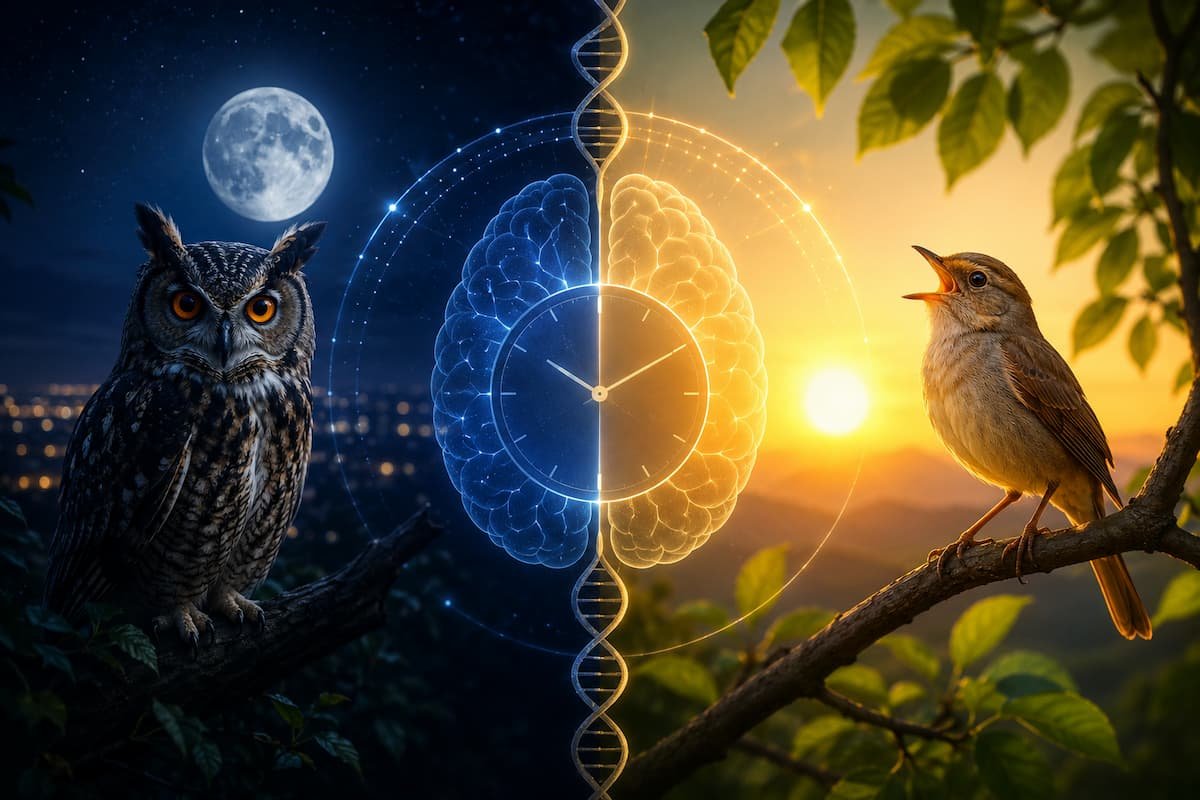
If you’ve ever been told you’re “lazy” for sleeping in past 9 AM, or that you “lack discipline” for staying up until 2 AM, here’s the truth: your body clock was largely decided before you were born. The science of chronotypes—whether you’re a morning lark or a night owl—isn’t about willpower. It’s about biology, genetics, and the molecular machinery ticking inside nearly every cell of your body.
For decades, society has worshipped at the altar of the early riser. “The early bird catches the worm.” “Early to bed, early to rise.” We’ve built schools that start at 7:30 AM, offices that expect peak performance at 8:00 AM, and a culture that treats night owls as somehow morally deficient. But modern chronobiology is tearing that narrative apart, piece by piece.
The Genetic Blueprint Inside Your Cells
Let’s start with the numbers because they tell a compelling story. Twin and family studies conducted across the United States, the United Kingdom, Scandinavia, and Brazil have consistently estimated the heritability of chronotype at approximately 50%. That means roughly half of the variation in whether you’re a morning person or an evening person comes down to your DNA.
But it gets more specific. In 2019, researchers from the University of Exeter and 23andMe published a landmark genome-wide association study (GWAS) analyzing nearly 700,000 individuals. They identified 351 genetic loci associated with chronotype—up from just 24 in earlier studies. These loci are enriched for genes involved in circadian regulation, cAMP signaling, glutamate pathways, and insulin signaling.
The SNP-based heritability from that massive dataset came in at 13.7%, which might sound lower than the 50% from twin studies. That’s because SNP heritability only captures common genetic variants, while twin studies capture the full genetic picture, including rare variants and gene-gene interactions.
Key takeaway: Whether you spring out of bed at 5 AM or hit your stride at midnight, your preference isn’t a character flaw—it’s a genetic trait as real as your eye color or blood type.
The Clock Genes Running the Show
Deep in your hypothalamus sits a cluster of about 20,000 neurons called the suprachiasmatic nucleus (SCN)—your body’s master clock. But here’s what most people don’t realize: nearly every tissue in your body has its own peripheral clock. Your liver, heart, muscles, and even your skin cells keep time through a molecular feedback loop involving a handful of core genes.
The stars of this show are CLOCK, BMAL1, PER1, PER2, PER3, CRY1, and CRY2. These genes operate in a beautifully choreographed dance: CLOCK and BMAL1 proteins pair up to activate PER and CRY genes, whose protein products then accumulate, travel back to the nucleus, and shut down their own production. The cycle takes roughly 24 hours.
Variations in these genes shift the timing of this loop. The PER3 gene, for instance, has a variable number tandem repeat (VNTR) polymorphism that’s one of the most replicated genetic associations with chronotype. People with longer PER3 variants tend toward morningness, while shorter variants skew evening.
Other genes like NR1D1 and NR1D2 also oscillate in circadian patterns and have been linked to chronotype differences. A 2025 study analyzing clock gene expression in early and late chronotypes found that genes like PER1, PER2, PER3, CRY1, NR1D1, and NR1D2 all oscillate in circadian manners—though the exact phase shifts between chronotypes remain an active area of investigation.
Your Brain on Chronotype: What Neuroimaging Reveals
Does being a night owl actually change how your brain works? The answer appears to be yes—subtly but measurably.
Research using functional MRI has shown that evening chronotypes exhibit different patterns of resting-state functional connectivity compared to morning types. One study found that evening-oriented participants showed reduced connectivity within the default mode network (DMN)—the brain network active when you’re daydreaming, reflecting, or not focused on the outside world. The DMN includes the posterior cingulate cortex, precuneus, and medial prefrontal cortex.
Evening types also show less medial prefrontal cortex reactivity during reward anticipation and more ventral striatum reactivity during win outcomes, suggesting reduced regulatory control and elevated reward sensitivity. This neural signature may help explain why evening chronotypes are more prone to substance use and impulsive behaviors.
Interestingly, a 2023 study demonstrated that machine learning classifiers could distinguish extreme early and late chronotypes with up to 97% accuracy using resting-state fMRI data—though the differences were only detectable during evening scanning sessions. The classifier worked best when comparing brain networks during the time when one group was naturally alert and the other was fighting fatigue.
The Hidden Epidemic: Social Jetlag
Here’s where chronotype stops being a quirky personality trait and becomes a serious public health issue.
Social jetlag is the chronic mismatch between your biological clock and your social obligations—like when a night owl has to wake up at 6 AM for work, then sleeps until noon on weekends to recover. It’s called “jetlag” because the effect on your body is similar to flying across time zones every week.
Large population studies estimate that social jetlag affects up to 87% of the population, with the average person experiencing 1–2 hours of mismatch. Each hour of social jetlag is associated with a 33% increase in obesity risk, higher BMI, increased waist circumference, and elevated markers of metabolic dysfunction.
The metabolic damage occurs even when people get adequate sleep duration. You can sleep eight hours every night, but if those hours are misaligned with your chronotype, your glucose metabolism, insulin sensitivity, and inflammatory markers still suffer.
Critical insight: Social jetlag is not just about being tired. It’s a form of chronic circadian disruption that independently raises your risk of obesity, type 2 diabetes, cardiovascular disease, and depression—even if your total sleep hours look fine on paper.
Chronotype and Mental Health: The Data Doesn’t Lie
The relationship between evening chronotype and psychiatric disorders is one of the most robust findings in sleep medicine.
A comprehensive narrative review published in Frontiers in Psychiatry synthesized the evidence and found that:
- Evening chronotype is a risk factor for depressive disorders and substance use disorders
- Morning chronotype acts as a protective factor against these conditions
- Evening types with bipolar disorder tend to have more severe symptoms and comorbidities
- Evening chronotype is significantly associated with eating disorders, particularly binge eating
A 2025 meta-analysis of 38 studies confirmed these findings with hard numbers. Evening chronotype was associated with a doubled risk of depression (OR = 2.09) compared to morning types. Social jetlag of 2+ hours raised depression risk by 58% (OR = 1.58).
Among Chinese college students, evening types with social jetlag of 2+ hours had an astonishing 5.67 times higher odds of mild depression compared to well-aligned morning types.
How Chronotype Shifts Across Your Lifetime
Your chronotype isn’t static. It follows a predictable arc across the human lifespan.
| Life Stage | Typical Chronotype | Why It Happens |
|---|---|---|
| Early childhood | Morning-oriented | High melatonin production; early sleep-wake patterns |
| Adolescence | Strongly evening-oriented | Pubertal delay of circadian phase; peak “night owl” period |
| Young adulthood | Gradual shift earlier | Slow return toward morningness; social/work pressures |
| Middle age (35-50) | Intermediate/morning | Continued phase advance; work/family demands |
| Older adulthood (60+) | Strongly morning-oriented | Retirement reduces social jetlag; natural phase advance |
Social jetlag drops sharply after age 60, mostly because retirement removes the rigid work schedule that forces people out of bed against their biology. When people can finally sleep according to their internal clock, their social jetlag approaches just 20 minutes.
Can You Change Your Chronotype?
This is the question everyone asks, and the answer is nuanced.
Your core chronotype—your genetic predisposition—is largely fixed. But your expressed chronotype can shift temporarily through environmental interventions:
Light exposure is the most powerful zeitgeber (time-giver). Bright light in the morning advances your clock, making you feel sleepy earlier. Bright light in the evening delays it, keeping you awake longer. This is why screen time before bed is so damaging for night owls—the blue light tricks your brain into thinking it’s still daytime.
Melatonin supplements taken in the early evening can help shift timing earlier for those who need to adapt to early schedules.
Meal timing also matters. Eating late at night signals to your peripheral clocks (especially in the liver) that it’s still “daytime,” further delaying sleep onset.
But here’s the catch: these interventions can shift your behavioral sleep timing, but they don’t change your underlying biology. A night owl forced into an early schedule is still a night owl—just a chronically sleep-deprived, socially jetlagged one.
Bottom line: You can nudge your sleep timing by an hour or two with disciplined light and meal management. But you can’t turn a genetic night owl into a natural lark any more than you can turn a left-handed person right-handed. The biology simply isn’t that flexible.
What Should Society Do About This?
The implications of chronotype science extend far beyond individual sleep hygiene.
School start times are perhaps the most urgent issue. Teenagers are biologically programmed for later sleep times due to pubertal phase delay. Yet most U.S. high schools start before 8:00 AM. The American Academy of Pediatrics has recommended start times of 8:30 AM or later, but implementation remains spotty.
Flexible work hours aren’t just a perk—they’re a public health intervention. Companies that allow employees to work during their chronotypic peak hours see better performance, fewer errors, and lower burnout rates. For night owls, this means starting at 10 AM instead of 8 AM.
Shift work is where chronotype science becomes literally life-or-death. Research shows that evening chronotypes adapt better to night shifts, while morning types handle early shifts more naturally. Yet most shift assignments ignore chronotype entirely, assigning schedules randomly. This mismatch contributes to the well-documented health risks of shift work, including increased cancer risk, cardiovascular disease, and metabolic disorders.
The Real Talk: Stop Shaming, Start Accommodating
We’ve built a society that treats 9-to-5 as the moral default, as if waking up early is a virtue and staying up late is a vice. The science says that’s nonsense. Your chronotype is a biological trait encoded in hundreds of genetic loci, shaped by evolution, and expressed through molecular clocks in nearly every cell of your body. It’s not laziness. It’s not a lack of discipline. It’s not a choice you made one Tuesday and can unmake the next.
The next time someone tells you to “just go to bed earlier,” remember: you’re asking a night owl to do the biological equivalent of a left-handed person writing with their right hand. They can do it, but it will never feel natural, and forcing it every day causes real harm.
“The health effect of social jetlag probably has both acute and chronic components. The immediate consequences of interrupted and insufficient sleep would contribute to the acute effects, while the strain on metabolism by being active and eating at the wrong biological times would accumulate as the chronic effects.” — Chronobiology Research, NIH
We need workplaces that accommodate chronotypes. Schools that respect adolescent biology. Healthcare that screens for social jetlag. And a culture that finally understands: some people are built for dawn, others for midnight—and both are perfectly valid ways of being human.
Remember: Your chronotype isn’t a bug in your operating system. It’s a feature. The real problem is trying to run everyone’s biological clock on the same schedule.
Sources and References
- Jones, S.E., et al. (2019). “Genome-wide association analyses of chronotype in 697,828 individuals provides insights into circadian rhythms.” Nature Communications. https://www.nature.com/articles/s41467-018-08259-7
- Kalmbach, D.A., et al. (2016). “Genetic Basis of Chronotype in Humans: Insights From Three Landmark GWAS.” Sleep Medicine Reviews. https://pmc.ncbi.nlm.nih.gov/articles/PMC6084759/
- Vetter, C., et al. (2016). “A twin study of genetic contributions to morningness-eveningness.” PMC. https://pmc.ncbi.nlm.nih.gov/articles/PMC4758835/
- Leocadio-Miguel, M.A., et al. (2021). “Compared Heritability of Chronotype Instruments in a Single Population Sample.” Journal of Biological Rhythms. https://journals.sagepub.com/doi/pdf/10.1177/07487304211030420
- “Chronotype, circadian rhythm, and psychiatric disorders.” Frontiers in Psychiatry. https://pmc.ncbi.nlm.nih.gov/articles/PMC9399511/
- “Sleep duration, chronotype, health and lifestyle factors affect cognition: a UK Biobank cross-sectional study.” BMJ Public Health (2025). https://bmjpublichealth.bmj.com/content/2/1/e001000
- “The Relationship of Sleep Duration, Chronotype, Social Jet Lag and the Risk of Depression: A Systematic Review and Meta-Analysis.” International Journal of Depression and Anxiety (2025). https://clinmedjournals.org/articles/ijda/
- “How can social jetlag affect health?” PMC – NIH. https://pmc.ncbi.nlm.nih.gov/articles/PMC10204006/
- Qu, Y., et al. (2023). “Association of chronotype, social jetlag, sleep duration and depressive symptoms in Chinese college students.” Journal of Affective Disorders. https://www.sciencedirect.com/science/article/pii/S016503272201206X
- “Social Jetlag and Related Risks for Human Health: A Timely Review.” Verda. https://www.verda.ie/s/Social-Jetlag-and-Related-Risks-for-Human-Health-A-Timely-Review.pdf

Aisha Patel is the main writer and editor at GameVolts, a site she built to make neuroscience and health research useful for everyday people. She covers sleep, digital wellness, beginner fitness, skin science, and productivity — always digging into the original studies rather than recycling headlines. Aisha started GameVolts because she kept finding wellness advice that contradicted itself and rarely linked to actual evidence. Her rule is simple: if she cannot explain the mechanism behind a claim, she does not publish it.