
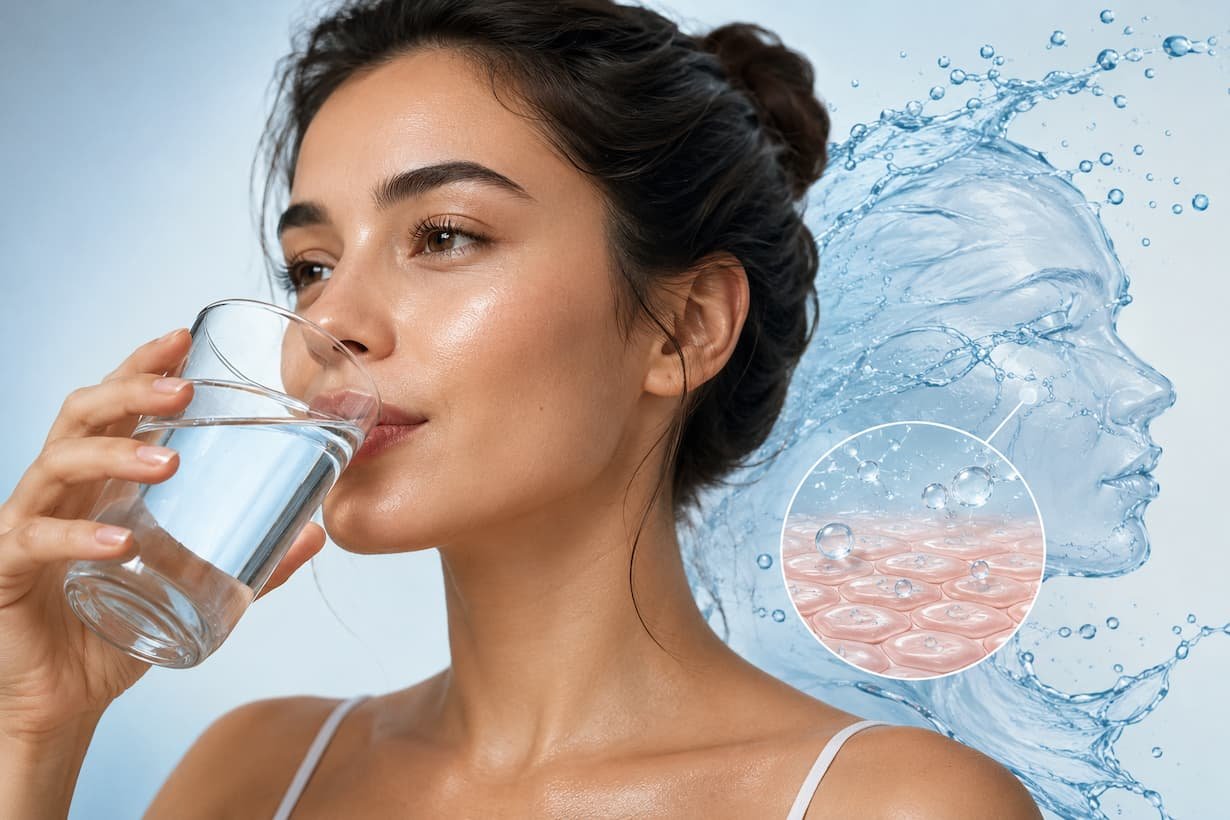
Every beauty magazine since the invention of print has pushed the same message: drink more water for glowing skin. Influencers chug bottles on camera. Wellness gurus swear by morning liters. But what does water actually do once it hits your stomach? Does it march straight to your cheeks and plump them up? The truth is messier, more interesting, and far less magical than the industry admits. Your skin is not a sponge waiting to be filled from the inside. It is a complex organ with its own hydration systems, and drinking water interacts with those systems in ways that matter—but do not transform.
What the Human Body Does With Water
Your body is roughly sixty percent water. Every cell floats in it. Every chemical reaction depends on it. But here is the critical distinction that marketing ignores: the water you drink does not travel directly to your skin surface like a pipeline filling a reservoir. It enters your bloodstream, gets distributed to every tissue based on physiological priority, and your skin receives whatever remains after more vital organs take their share.
- Brain and kidneys receive top priority for hydration
- Muscles and liver rank above skin in the distribution hierarchy
- Your epidermis is a lower-priority organ for water allocation
- Survival biology dictates this priority system, not beauty
This is not a flaw. It is survival. A slightly dull complexion will not kill you. Kidney failure will. Your body knows the difference even if wellness culture pretends otherwise.
The Stratum Corneum: Your Skin’s True Hydration Battleground
Your skin’s outermost layer, the stratum corneum, is only about 10-15% water by weight. The deeper dermis holds more—around 70%—, but this is structurally bound water that drinking does not directly alter. Surface hydration depends entirely on different factors than what you swallow.
| Skin Layer | Water Content | Controlled By | Drinking Water Impact |
|---|---|---|---|
| Stratum corneum (surface) | 10-15% | Barrier function, environment, topical products | Minimal |
| Epidermis (middle) | 30-50% | Natural moisturizing factors, cell differentiation | Indirect |
| Dermis (deep) | ~70% | Blood flow, hyaluronic acid, systemic hydration | Moderate if dehydrated |
What Actually Happens During Dehydration
True dehydration is a systemic state, not a skin condition. When your body lacks sufficient water, blood volume drops. Your heart works harder. Your kidneys conserve fluid. Your brain slows certain functions. Your skin sees reduced blood flow and nutrient delivery as a lower-priority consequence.
- Fine lines become more visible due to reduced tissue turgidity
- Skin loses flexibility and feels tighter
- Barrier function may become slightly impaired
- Dead cell shedding slows down marginally
Rehydrating reverses these effects—but only to a point. If you were mildly dehydrated, drinking water restores normal blood flow and your skin returns to baseline. If you were already adequately hydrated, adding more water does not create superhuman radiance. Your kidneys simply excrete the excess.
The “8 Glasses” Myth: This rule appeared in a 1945 US Food and Nutrition Board recommendation. The original text noted most of this water comes from food. The food part was forgotten; the number stuck for eighty years.
Why “Toxin Flushing” Is Scientific Nonsense
“Drink water to flush toxins from your skin.” This phrase appears in thousands of beauty articles, and it is scientifically empty. Your body does not store toxins in your skin waiting for a flood of water to wash them out.
- Liver and kidneys handle detoxification through enzymatic processes
- Water supports these organs by maintaining blood volume and filtration rates
- No special detox pathway exists through your pores
- Pores excrete sebum, not toxins
- Sweat glands perform thermoregulation, not purification
If toxins were accumulating in your skin, you would need medical intervention, not a water bottle. The language of detox has been co-opted by wellness marketing because it sounds proactive. It is also meaningless in this context.
How Skin Actually Maintains Hydration
Your skin’s hydration depends on three primary factors. Understanding these clarifies why drinking water plays a smaller role than topical care.
1. Barrier Function
The stratum corneum acts as a brick wall. Corneocytes are the bricks. Lipids are the mortar. When this wall is intact, water stays inside. When it cracks, water escapes regardless of how much you drink.
2. Natural Moisturizing Factors
These water-soluble compounds include amino acids, urea, lactate, and salts. Your skin cells produce them as they differentiate. They draw water into cells from the surrounding environment. No amount of drinking water can replace them from the inside.
3. Dermal Hyaluronic Acid
This molecule binds enormous amounts of water relative to its weight, giving skin plumpness. But dermal hyaluronic acid is produced by your cells, not delivered by your drinking water. Topical serums can temporarily hydrate the surface, but drinking does not increase production.
What Adequate Hydration Actually Provides
This is not an argument against drinking water. Proper hydration is essential for health, and your skin reflects overall bodily function. The benefits are real but indirect.
- Improved blood flow delivers nutrients and oxygen to all tissues including skin
- Efficient kidney function reduces systemic inflammation
- Proper lymphatic movement prevents puffiness and supports immune surveillance
- Temperature regulation through sweat depends on adequate hydration
- Prevention of heat stress and subsequent inflammatory cascades
People who drink water regularly often have healthier lifestyles overall. They may eat more fruits and vegetables, exercise more, consume less alcohol, and sleep better. These habits collectively improve skin appearance. Attributing the glow solely to water is like crediting the cherry for the entire cake.
When Water Cannot Fix What Is Broken
Drinking water will not cure acne, eczema, psoriasis, or rosacea. These conditions have complex etiologies involving genetics, immune dysfunction, microbiome imbalance, and environmental triggers. No dermatologist prescribes increased water intake as a primary treatment for any of them.
| Skin Condition | Actual Cause | Water’s Role | Effective Treatment |
|---|---|---|---|
| Acne | Follicular hyperkeratinization, bacterial overgrowth, hormones | None | Retinoids, benzoyl peroxide, hormonal therapy |
| Atopic dermatitis | Filaggrin gene defect, barrier dysfunction, immune dysregulation | None | Emollients, topical corticosteroids, immunomodulators |
| Photodamage | UV-induced collagen breakdown, DNA damage | None | Sunscreen, retinoids, antioxidants |
| Hyperpigmentation | Melanin overproduction, inflammation, hormonal factors | None | Hydroquinone, azelaic acid, vitamin C |
How Much Water Is Actually Enough
The eight-glasses myth has no scientific origin. The National Academies of Sciences, Engineering, and Medicine suggest approximately 3.7 liters daily for men and 2.7 liters for women from all beverages and food combined. About twenty percent comes from food.
- Actual fluid intake needs: roughly 3 liters for men, 2.2 liters for women
- These are averages, not prescriptions
- Individual needs vary by body size, activity, climate, and health
- Thirst is a reliable indicator for most healthy people
- Dark urine, headache, and fatigue signal later-stage dehydration
Overhydration is also possible. Drinking excessive water beyond what kidneys can excrete dilutes blood sodium, causing hyponatremia. This is potentially dangerous. More is not better. Adequate is adequate.
Bottom Line: If your skin is persistently dry despite drinking adequate water, the issue is almost certainly barrier dysfunction or environmental factors. A humidifier and ceramide moisturizer will outperform another glass of water every time.
Related Articles
- How Your Skin Renews Itself Every 28 Days — Understanding the renewal cycle clarifies why topical care matters more than drinking for surface moisture.
- Oily, Dry, or Combination: Skin Type Myths Debunked — Separates myth from mechanism so you stop chasing hydration in the wrong places.
- Hyperpigmentation: The Real Science Behind Dark Spots — Explains what actually drives discoloration when water cannot help.
- Why Sun Damage in Your 20s Shows Up in Your 40s — The single biggest factor in skin aging that water cannot reverse.
- Stress Breakouts Are Real — Cortisol Leaves Evidence on Your Face — Maps the hormonal pathway that worsens every skin condition regardless of hydration.
Sources and References
- Popkin BM, D’Anci KE, Rosenberg IH. “Water, hydration, and health.” Nutrition Reviews, 2010. Comprehensive review examining physiological roles of water and critiquing common hydration myths including the eight-glasses recommendation.
- Williams S, Krueger N, Davids M, Kraus D, Kerscher M. “Effect of fluid intake on skin physiology: distinct differences between drinking mineral water and tap water.” International Journal of Cosmetic Science, 2007. Compares water sources and their measurable effects on skin parameters.
- Palma L, Marques LT, Bujan J, Rodrigues LM. “Dietary water affects human skin hydration and biomechanics.” Clinical, Cosmetic and Investigational Dermatology, 2015. Demonstrates higher water intake positively impacts skin hydration in individuals with lower baseline consumption, with diminishing returns in already-hydrated subjects.
- Proksch E, Brandner JM, Jensen JM. “The skin: an indispensable barrier.” Experimental Dermatology, 2008. Details barrier mechanisms controlling skin surface hydration and explains why systemic hydration has limited direct impact.
- Rawlings AV, Matts PJ. “Stratum corneum moisturization at the molecular level: an update in relation to the dry skin cycle.” Journal of Investigative Dermatology, 2005. Explains molecular basis of skin surface hydration, including natural moisturizing factors and their independence from drinking water.
- Verdier-Sévrain S, Bonté F. “Skin hydration: a review on its molecular mechanisms.” Journal of Cosmetic Dermatology, 2007. Clarifies distinction between dermal hydration influenced by systemic factors and epidermal hydration dependent on local barrier function.
This article was prepared to provide a scientifically grounded perspective on a topic surrounded by misinformation. The goal is to help readers understand what water actually contributes to skin health and avoid neglecting more impactful interventions. This content is for educational purposes and does not constitute medical advice.

Aisha Patel is the main writer and editor at GameVolts, a site she built to make neuroscience and health research useful for everyday people. She covers sleep, digital wellness, beginner fitness, skin science, and productivity — always digging into the original studies rather than recycling headlines. Aisha started GameVolts because she kept finding wellness advice that contradicted itself and rarely linked to actual evidence. Her rule is simple: if she cannot explain the mechanism behind a claim, she does not publish it.