
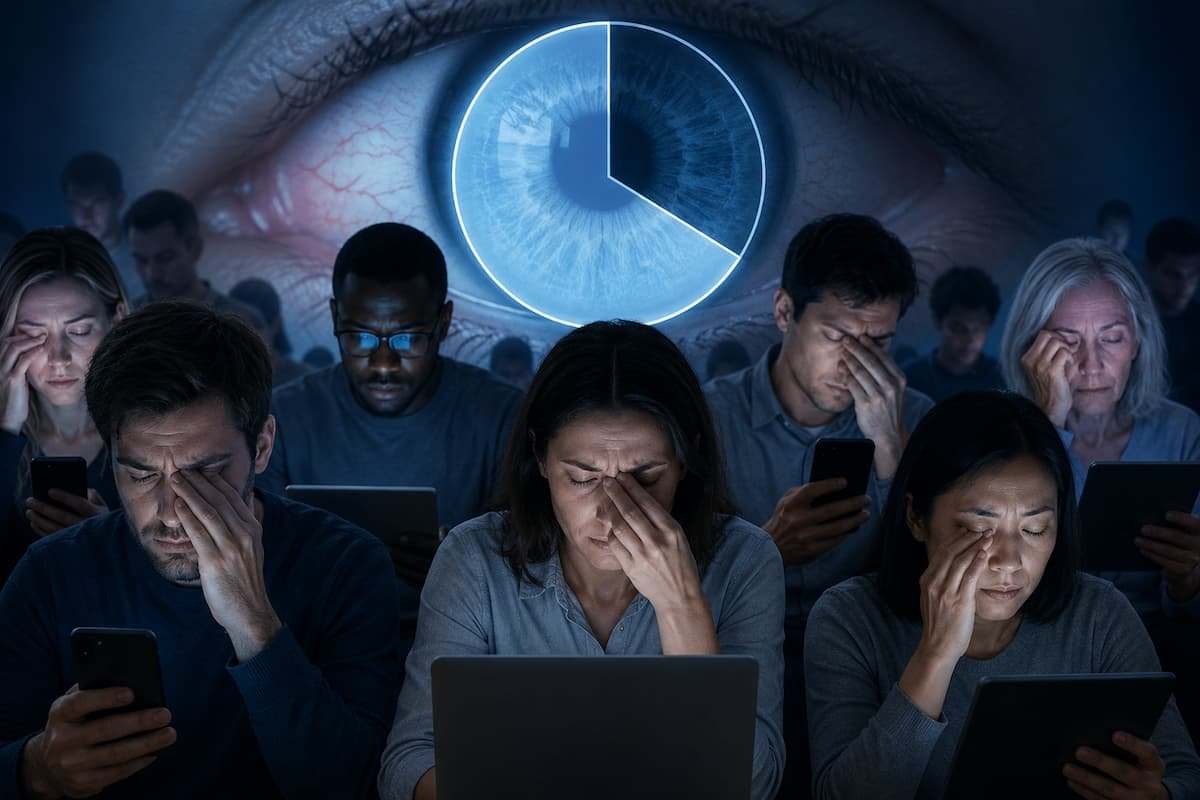
There is a moment most people recognize. It happens around 3 p.m. on a Tuesday. Your eyes feel like they have been sandblasted. The screen in front of you seems to shimmer slightly, and no amount of rubbing makes the blur go away. You tell yourself it is just fatigue. You grab another coffee. You keep scrolling. But this is not fatigue. This is the most widespread occupational health crisis of the digital age, and the data from 2025 confirms it has only deepened.
The clinical term is Computer Vision Syndrome (CVS), though most people simply call it digital eye strain. Whatever label you prefer, the reality is identical: prolonged screen exposure is damaging the eyes of the majority of working-age adults worldwide. A 2025 comprehensive literature review published in Taylor & Francis reaffirmed the global prevalence at 69.0%, cementing what researchers have suspected for years — this is no longer a fringe concern. It is the default condition of modern life.
What the 2025 Studies Are Telling Us
While the headline figure of 69% comes from a pooled meta-analysis, individual country studies in 2025 paint an even more granular — and in some cases, more alarming — picture.
In Oman, a cross-sectional study of 293 university students published in BMC Public Health in 2025 found a CVS prevalence of 73.7%. The most common symptoms were not subtle: headache affected 52.4% of participants, eye strain and fatigue hit 45.7%, and dry eyes troubled 25.9%. What stood out was the ergonomic negligence. Students with uncomfortable sitting postures were twice as likely to develop CVS. Those who held screens too close — less than the recommended distance — saw prevalence spike to 84.5%.
Meanwhile, in Peru, researchers evaluated 502 health science students and recorded a CVS prevalence of 78.1%. Medical students were hit hardest. The study, published in Frontiers in Public Health in April 2025, also uncovered a novel association: the severity of nomophobia—the fear of being without a mobile phone—correlated directly with CVS severity. Students with severe nomophobia were more than twice as likely to suffer from digital eye strain. It was one of the first studies to formally link smartphone dependency behavior to measurable ocular damage.
In Saudi Arabia, a 2025 study in the Journal of Education and Health Promotion reported prevalence rates ranging from 43.5% to 77.6% across different regions, highlighting how workplace ergonomics, healthcare access, and screen habits create dramatic geographic disparities even within a single country. “The conversion of classes from physical to digital space after the COVID-19 pandemic led to a sustained elevation in CVS that has not meaningfully declined.”
Screen Time Has Not Plateaued — It Has Accelerated
If you think people have started cutting back, the numbers suggest otherwise. A 2025 Nielsen analysis found that the average adult now spends over 11 hours per day consuming media across devices. Smartphones alone account for 3 hours and 35 minutes. Television adds another 4 hours and 21 minutes. Computers and tablets fill in the rest.
Remote work, once a pandemic anomaly, has calcified into permanent policy for roughly 40% of the U.S. workforce. The result is that millions of adults who previously commuted, walked between meetings, or glanced out office windows now spend entire days in fixed positions, staring at monitors positioned at questionable angles in improvised home offices.
The economic toll is not trivial either. One 2025 estimate places annual workplace productivity losses from digital eye strain at over $2 billion in the United States alone. That figure accounts for reduced work speed, increased error rates, absenteeism, and the sheer volume of ophthalmology visits prompted by screen-related complaints.
| Study / Region | Year | Sample Size | CVS Prevalence |
|---|---|---|---|
| Global Meta-Analysis (103 studies) | 2023 (pooled) | 66,577 | 69.0% |
| University Students, Oman | 2025 | 293 | 73.7% |
| Health Science Students, Peru | 2025 | 502 | 78.1% |
| General Population, Saudi Arabia | 2025 | Varied | 43.5% – 77.6% |
| Older Adults (60+), Ireland | 2025 | 401 | 51.6% |
| Heavy Computer Users (Global) | 2025 | Multiple | ~90% |
The Mechanisms: Why Screens Destroy Comfort
The biology is not complicated, but it is relentless. When you focus on a screen, three things happen in rapid succession.
- First, your blink rate collapses. Normally, humans blink 15 to 20 times per minute. During screen use, that rate can drop by half. Fewer blinks mean the tear film—the thin, protective layer of fluid coating your cornea—breaks up faster. The result is dryness, burning, and that persistent gritty sensation that sends people to pharmacies for lubricating drops.
- Second, your focusing muscles lock up. The ciliary muscles inside your eye are designed for dynamic work: shifting focus between near and far objects, adjusting for depth, and accommodating changes in light. A screen demands sustained near-focus for hours. It is the visual equivalent of holding a squat position until your legs shake.
- Third, your posture deteriorates. Screens positioned too high force you to tilt your head back. Screens are too low, crane your neck forward. Over months and years, this produces the familiar constellation of neck pain, shoulder stiffness, and tension headaches that often accompany — and are mistaken for — pure eye strain.
- Critical Insight: A 2025 study of older adults in Ireland found that even among people aged 60 and older using devices for just 4 hours daily, 71% reported symptoms of digital eye strain. Smartphones were the most-used devices, but tablets were used for the longest continuous durations. Vision correction alone did not eliminate symptoms.
Who Gets Hit the Hardest?
The meta-analysis and subsequent 2025 studies reveal clear patterns in who suffers most.
- Women show a higher prevalence (71.4%) than men (61.8%). Hormonal influences on tear production, greater likelihood of autoimmune-related dry eye, and differences in reporting behavior all likely contribute.
- University students are the single most affected group, with pooled prevalence reaching 76.1%. The combination of academic screen time, recreational device use, irregular sleep, and poor ergonomics in dorm rooms or shared housing creates a perfect storm.
- Contact lens wearers fare worse (73.1%) than those who do not wear lenses (63.8%). Contact lenses already disrupt the tear film and reduce corneal oxygenation. Adding hours of screen time compounds both problems.
- People with pre-existing refractive errors—myopia, hyperopia, and astigmatism—experience significantly worse symptoms when those errors are uncorrected or under-corrected. A 2025 Oman study found that students with refractive errors had a CVS prevalence of 93.7% compared to 68.3% in those without.
Prevention Is Boring — And Necessary
There is no miracle cure. No blue-light-blocking glasses have demonstrated clinical superiority over basic behavioral changes in peer-reviewed trials. No app can blink for you. The interventions that work are unglamorous, repetitive, and effective.
- Distance matters. Keep monitors at least 20 to 28 inches away. Position the top of the screen at or slightly below eye level. For smartphones, hold the device no closer than 40 centimeters from your face.
- Lighting matters. Your screen should not be the brightest object in your visual field. Reduce ambient-screen contrast. Use matte filters to cut glare. Position monitors perpendicular to windows, not facing them.
- Breaks matter. The famous 20-20-20 rule — every 20 minutes, look 20 feet away for 20 seconds — remains a useful heuristic, though 2025 research suggests longer breaks (60 to 120 seconds) may be more effective for symptomatic users. The key is not the exact interval; it is the interruption of sustained near-focus.
- Tears matter. Preservative-free artificial tears used several times daily can stabilize the tear film for people who cannot reduce screen time. They are not a substitute for breaks, but they are a valuable adjunct.
- Exams matter. A comprehensive eye examination can identify uncorrected refractive errors, binocular vision dysfunction, or dry eye disease that screens merely unmask. Many adults have not had their prescriptions updated in years.
We are not going back to a pre-digital world. The screens are here to stay, and in many ways, they have made life richer, more connected, and more efficient. But our eyes did not evolve for 11 hours of daily near-focus. They evolved for savannas, horizons, and shifting distances. The two-thirds figure is not a scare tactic. It is a mirror. It reflects how we live now. And it asks a simple question: are we willing to make small, consistent adjustments — or will we wait until the discomfort becomes damage?
Your eyes are already voting. They are sending you signals every afternoon. The only question is whether you are listening.
Sources and References
- Kahal F, et al. “Computer vision syndrome: a comprehensive literature review.” Taylor & Francis. 2025. https://www.tandfonline.com/doi/full/10.1080/20565623.2025.2476923
- Almuqrashi A, et al. “The prevalence of computer vision syndrome and associated factors among university students in Oman: a cross-sectional study.” BMC Public Health. 2025. https://link.springer.com/article/10.1186/s12889-025-23823-9
- Lopez-Choquegonza R, et al. “Computer vision syndrome and its associated factors in health science students from a university in Peru.” Frontiers in Public Health. 2025. https://www.frontiersin.org/journals/public-health/articles/10.3389/fpubh.2025.1485515/full
- Alhassan MA, et al. “Burden and determinants of computer vision syndrome in university students.” Journal of Education and Health Promotion. 2025. https://journals.lww.com/jehp/fulltext/2025/12290/burden_and_determinants_of_computer_vision.540.aspx
- Ccami-Bernal F, et al. “Prevalence of computer vision syndrome: A systematic review and meta-analysis.” Journal of Optometry. 2024. https://www.journalofoptometry.org/en-prevalence-computer-vision-syndrome-a-articulo-S1888429623000304
- “Digital eye strain and clinical correlates in older adults.” Contact Lens and Anterior Eye. 2025. https://www.sciencedirect.com/science/article/pii/S136704842400242X
- “Digital Eye Strain: Complete 2026 Guide.” West Broward Eye Care. 2026. https://www.westbrowardeyecare.com/digital-eye-strain-complete-2025-guide-to-symptoms-causes-effective-management-strategies/
- “Digital Eye Strain in 2026: Causes & Fixes.” BYNOCS. 2025. https://bynocs.com/blogs/digital-eye-strain-in-2026-causes-fixes/
- Barodawala FS, et al. “Symptom-based prevalence and risk factors of digital eye strain during COVID-19 pandemic in Selangor, Malaysia.” Malaysian Journal of Public Health Medicine. 2025;25(1):153-163. https://researchspace.auckland.ac.nz/bitstreams/69389628-4146-408c-81cc-1cfc802279c9/download
- “Digital Eye Strain: How Screens Affect Your Eyes & Solutions.” Spectacular Eyewear. 2025. https://spectaculareyewear.net/how-digital-devices-are-affecting-your-eye-health-what-recent-studies-reveal/

Aisha Patel is the main writer and editor at GameVolts, a site she built to make neuroscience and health research useful for everyday people. She covers sleep, digital wellness, beginner fitness, skin science, and productivity — always digging into the original studies rather than recycling headlines. Aisha started GameVolts because she kept finding wellness advice that contradicted itself and rarely linked to actual evidence. Her rule is simple: if she cannot explain the mechanism behind a claim, she does not publish it.